
Some Thoughts on the Flora Of South Texas After Seeing It in Mexico…
In December I flew to San Luis Potosi and spent 12 days doing vigorous field botany throughout the states of San Luis Potosi,
Querétaro, Hidalgo, Mexico, Puebla, and Oaxaca. This consisted of meeting up with two different friends that live there, going out every day and photographing, documenting and filming every wild plant species that I came into contact with. Photographs were uploaded to the site inaturalist as well as to my own cloud database, and every observation of a plant species then had various notes attached to it such as habitat type, elevation, sympatric species, presence of pollinators, geologic substrate (all mostly limestone) and so on.
Throughout the open valley basins, mountainsides, and sketchy winding one-land roads we traversed across, I couldn’t help but notice that so many of the plants that I know from South Texas also grew in Mexico, and that - more importantly - they all looked so much healthier than they did in Texas. As of February 2026, South Texas is in an epic drought, so it’s not hard to imagine that the Texas populations of most Tex-Mex plants look to be in worse shape than their Mexican counterparts. South Texas is also at a much lower elevation - and is thus a much hotter climate year-round - than most of Mexico.
Cordia boissieri, Senegalia berlandieri, Jatropha dioica, Karwinskia humboldtii, Hibiscus martianus, Nahuatlea hypoleuca - all of these looked incredibly healthy in Hidalgo, Mexico, where they grew at 5500’ elevation. In Hidalgo, Senegalia berlandieri and Nahuatlea hypoleuca become single-trunked small-to-medium-sized trees rather than the multi-stemmed scraggly individuals that you only ever see them reaching in South Texas.
Seeing this made me realize that perhaps the only reason that these plants were in South Texas to begin with was due to the late Pleistocene cooling from roughly 2 million to 11 thousand years ago, when all of lower-latitude North America was much cooler and milder of a climate than it is now. This “cooling” likely allowed the plants that thrived in the mountains of Mexico to the South to “come down” to the hotter, lower-elevation South Texas plains to the North. It begs the question though - what grew in the plains and undulating hills of South Texas prior to this cooler period, though?
Did Stenocereus huastecorum - a multi-stemmed columnar cactus that grows only a hundred miles South of the Texas border - at one point grow in Texas along with other freeze-intolerant plants that now only occur in Mexico, such as Decatropis bicolor (rutaceae)?
Keep in mind that Texas is just basically Mexico, in keeping with the floristic affinities that span across very recent geopolitical borders. If you step into the mountains of Nuevo Leon at elevations of 5,000-7000 feet near places like Aramberri, you can catch a glimpse of what the Edwards plateau and Balcones escarpment may have looked like 600 years ago before it was turned into private, inaccessible land surorunded by strip malls and cul-de-sacs. Most of the same plants grow in both places, the geology is still limestone, etc. Many Mexican plants reach their Northern limit in Central Texas, such as Taxodium mucronatum, etc. There are beautiful rolling hills covered in Monarda and Junipers and Oaks in the Nuevo Leon region, as well. In between the higher elevations of the edwards plateau and the Sierra Madre lies the Rio Grande Valley, which is hotter than most places in Mexico. Here there are slightly different ecotypes of widespread plant species, these ecotypes being adapted to and selected for a much hotter, lower-elevation climate. There are also different ecotypes of many different plant species that exist in both South Texas (which is hotter and more humid) and West Texas (which is drier and cooler throughout the year)...examples include : Sidneya tenuifolia, Lophophora willamsii, Jatropha dioica, Hamatocactus hamatacanthus. I am less familiar with the North and East Texas area than I am with the South and West.
"No coviene, por otra parte, perder de vista el hecho de que la reparticion geografica de los organisms por lo general have caso omiso de las divisiones politicas de la corteza de nuestro planeta, en cambio con frecuencia esta ligada con la delimitacion de regiones naturales, definidas por condiciones fisiograficas, climaticas, edaficas, etc. Para ser congruente con tal circumstancia y dar cuenta de muchos endemismos verdaderos, sera necesario en esta capitulo extender las fronteras del pais y asi, se recurrira al termino megamexico, cuando se incluytan las partesde las zonas aridas sonorense, chihuahuaense y tamaulipeca, que pertenecen a los estados unidos de america, al termino de "Megamexico2", cuando se abarque el territoria centroamericano hasta el norte de Nicaragua y al termino "Megamexico 3" para comprender ambas extensiones (veanse los mapas de la figura 2) "- Jerry Rzedowski, Diversidad y Origenes de la Flora Fanerogámica de Mexico
"On the other hand, it is important to remember that the geographic distribution of organisms generally ignores the political divisions of the planet's crust and is instead frequently linked to the delimitation of natural regions defined by physiographic, climatic, edaphic, etc. conditions. To be consistent with such circumstances and to account for many true endemisms, it will be necessary in this chapter to extend the country's borders, and thus the term megamexico will be used when including parts of the arid zones of Sonora, Chihuahua, and Tamaulipas, which belong to the United States of America; the term "Megamexico2" when covering the Central American territory as far north as Nicaragua; and the term "Megamexico 3" to include both areas (see maps in Figure 2)" - Jerzy Rzedowski, Diversidad y Origenes de la Flora Fanerogámica de Mexico
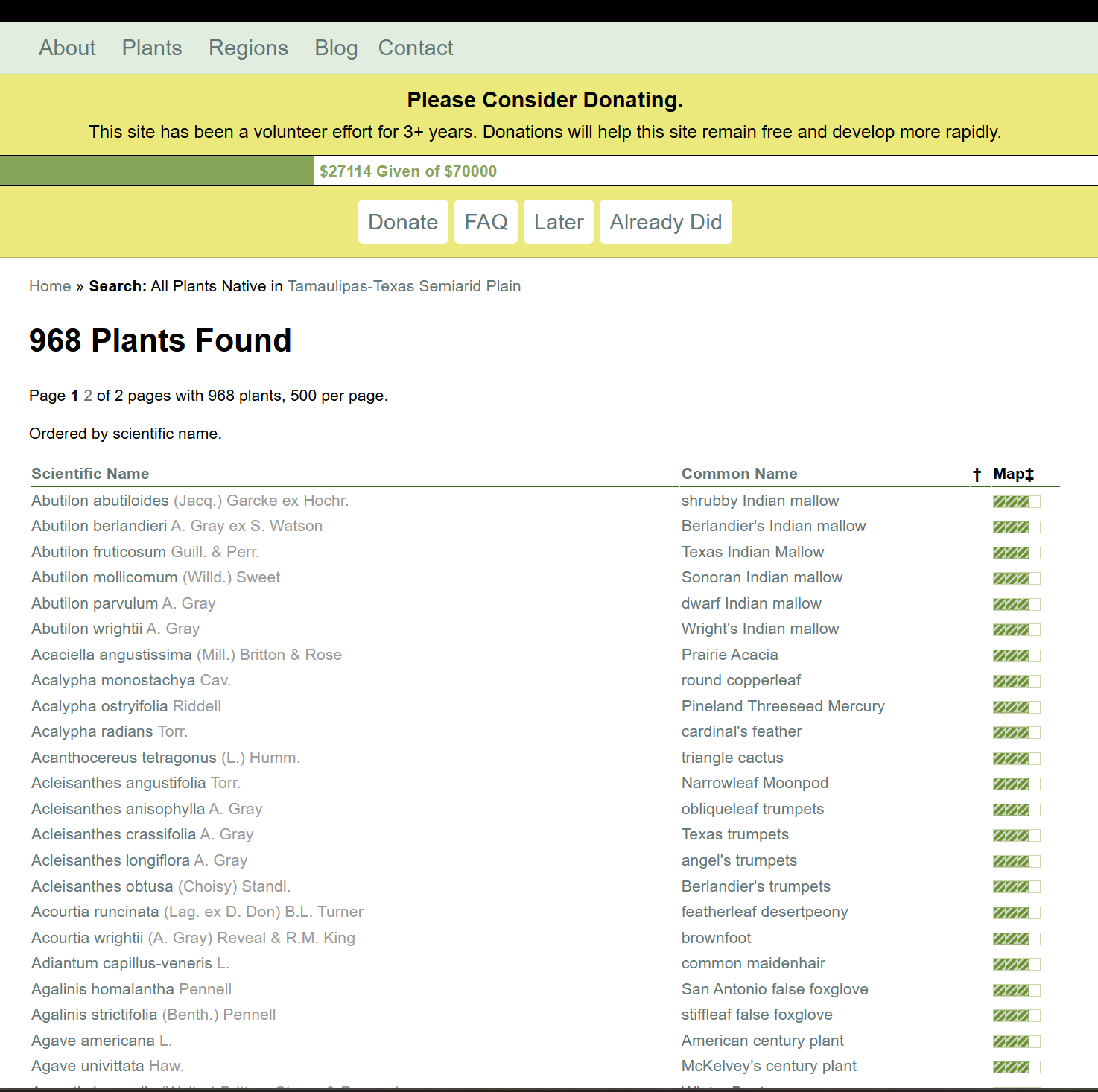
GETTING NATIVE PLANT LISTS FOR YOUR REGION ON BPLANT.ORG
Visit bplant.org and follow the link below. After arriving on the main page, click on “REGIONS”. You will arrive at a page with a map on it. Click on your region. You will then arrive at a map of your region with a diagram of subregions. Click on your subregion, then at the bottom of the page click on “list native plants”, and you will arrive at a page listing the genus and species and common name of all native plants found in your region.
Visualizing the Urban Heat Island
I found myself explaining the Urban Heat Island to a cop a few nights ago after a lady in the neighborhood called the cops on me for planting trees on city property next to her house. This is the second time this has happened to me in the town I live in, a region inhabited by a populace that I (only half-jokingly) frequently refer to as “hating trees”. For many, this is hard to understand : why anybody would hate trees. Shit, it was a hard concept for me to understand until I experienced it.
South Texas is known for its high rate of illiteracy and obesity, among other things. People can be incredibly kind here, and the general risk of having your shit stolen by crackheads (not at all uncommon where I used to live) and then shamed for being upset about it by a 25-year-old “anarchist” with rich parents (also not at all uncommon where I used to live) is relatively low. Those are the pros. I mention them because I am about to get to the cons, which are an abundance of automobile-dependent infrastructure (which itself encourages physical health decline and discourages exercise) & a dominant culture (certainly upwards of 50% of the populace) that for the most part hates trees and native plants, mostly because they are supposedly “messy”. In this cultural climate (remember, culture is mostly subconsciously spread by humans due to our social propensity to run with our herd, ie. to conform to whatever happens to be the dominant paradigm in a given area), concrete and asphalt are seen as “clean” whereas plants are seen as “messy” and “inviting snakes”. This kind of cultural zeitgeist is by no means endemic to South Texas. It occurs in many places throughout the United States in regions where the human infrastructure is bleak enough and most of the native habitat has been eradicated. This kind of mindset is neither partial to the rich or to the poor, as I’ve heard it espoused by both classes. It does, however, represent a complete disconnection from - and usually a fear of - “nature” and the biosphere of planet Earth itself. It is a mindset that is both corny as hell and nauseating, and I focus on its pervasiveness in South Texas because this is the first place I have lived where I have seen it to such a dominant extent.
I can understand why people dislike native plants if they have no experience with them. Often when people tell me that they “like plants”, I come to find out (to no surprise) that they generally mean horticultural garbage (normally cultivars bred for aesthetic) and houseplants, things that generally make me yawn and couldn’t hold my attention anymore than a golf convention. Liking “native plants” means something different : it means enjoying plants that have a context for the region where one lives, and being educated enough to understand that both evolution via natural selection as well as ecology tie those plants to the history of that place.
Yet even if a person doesn’t know (or doesn’t care) about all that, I would generally like to be able to assume that most people know the benefits of plants, whether they are native or not. Trees for instance, provide shade. Roots break up soil and help water infiltrate during high rainfall events. Leaves “catch pollution” and prevent particulate exhaust from settling on windowsills and cars (something I had extensive experience with in my old neighborhood in oakland, where you could spit on your finger and run it along the windowsill and have it come up black).
Since moving to South Texas, among the many ecological services provided by trees and perennial shrubs, the offer of shade came to be the most important to me. South Texas is the hottest climate anywhere in the United States. Phoenix may get individually hotter days in the summer, but Phoenix also gets substantially cooler than South Texas in the winter. Just the other day here in South Texas, it was 91 degrees fahrenheit on January 14th. We get maybe one month a year where temperatures may even reach down to the low 40s at night. When you understand this, it is no wonder that plants like Peyote and Astrophytum grow native and thrive down here.
The reason that shade is so important is that concrete and asphalt are basically “heat batteries”. They are heat batteries that are “charged” by the sun, and to reduce their effectiveness as heat batteries, one needs to prevent the sun from “charging” them up by shading them. This is where trees come in. Did I stand any chance of explaining this to the cop, or to the lady who called the police on me for planting street trees? From the way his eyes began to wander when I was talking to him, I could tell it was not going to happen. He had the look of a bored high school student in science class who had long since given up trying to grasp any of the material. Let’s look at how the urban heat island works and why it’s such a bad problem in areas like commercial and residential areas in South Texas that have a large amount of land surface area covered in concrete and asphalt and a low amount of urban tree canopy cover :
THE URBAN HEAT ISLAND : CONCRETE AND ASPHALT AS “SPACE HEATERS”…
For a 6-inch thick asphalt slab starting at 141°F (60.6°C) on a calm, clear summer night with a low of 75°F (24°C), it would take approximately 12-14 hours for the surface to cool to within about 10°F of the ambient air temperature.
Asphalt doesn't cool like a cup of coffee. It's a solid slab losing heat from its surface. The interior heat must conduct to the surface before it can radiate away. This internal resistance is why cooling is slow.
This calculation reveals the severity of the problem:
The Night is Not Long Enough: With only ~10-12 hours of darkness in summer, the asphalt never reaches equilibrium with the night air. It's still actively radiating significant heat at sunrise.
Cumulative Heat Build-Up: On multi-day heat waves, each day starts with the pavement already pre-heated from the previous night, leading to even higher peak temperatures.
The "Space Heater" Metaphor : This 12-14 hour cooling time means the asphalt is indeed a vast, low-temperature radiator from sunset until just before dawn, directly causing the elevated nighttime urban temperatures.
Every new parking lot, road, and stretch of asphalt that is not somehow blocked from the sun, whether by trees or by sheet metal purgalo structures and carports, must be seen for what it is : a layer of material that will effectively become a night-time space heater during the summer.
Appreciation for the Mallows...
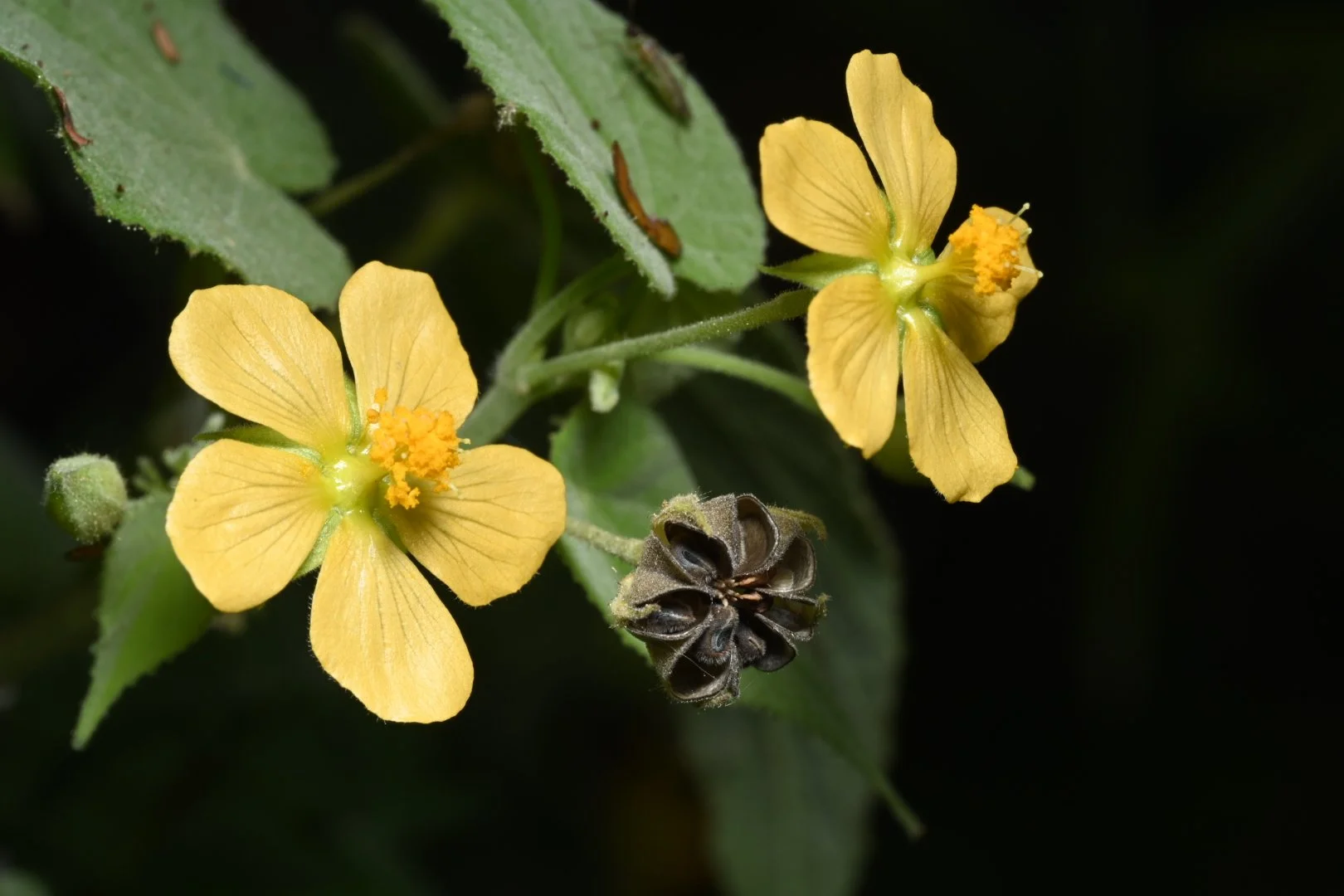
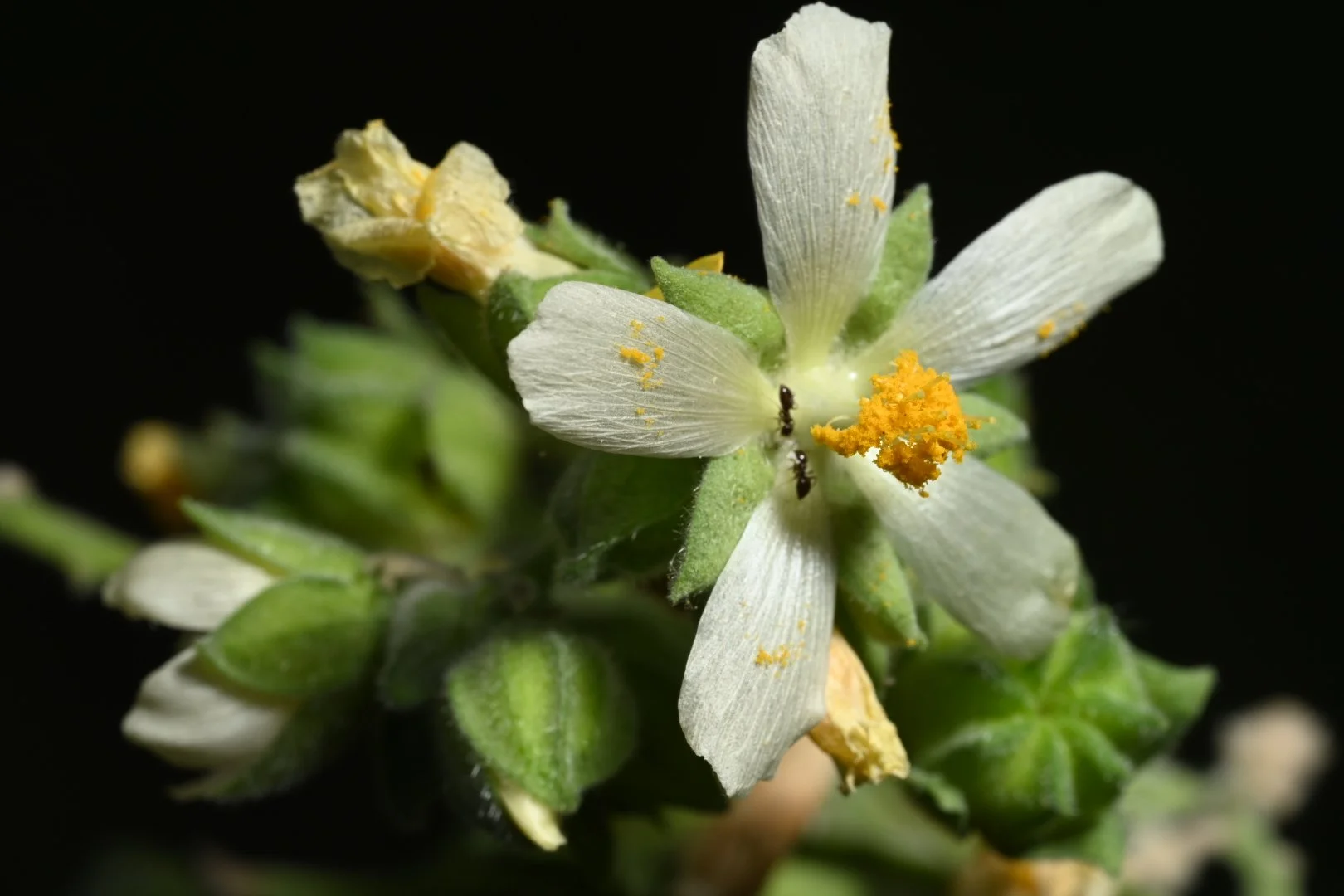
In South Texas and many other tropical areas the cotton,mallow and hibiscus family - Malvaceae - is dominant. Members of this family are marked by a number of key unifying factors - known as *synapomorphies* - that distinguish them as evolutionarily related.
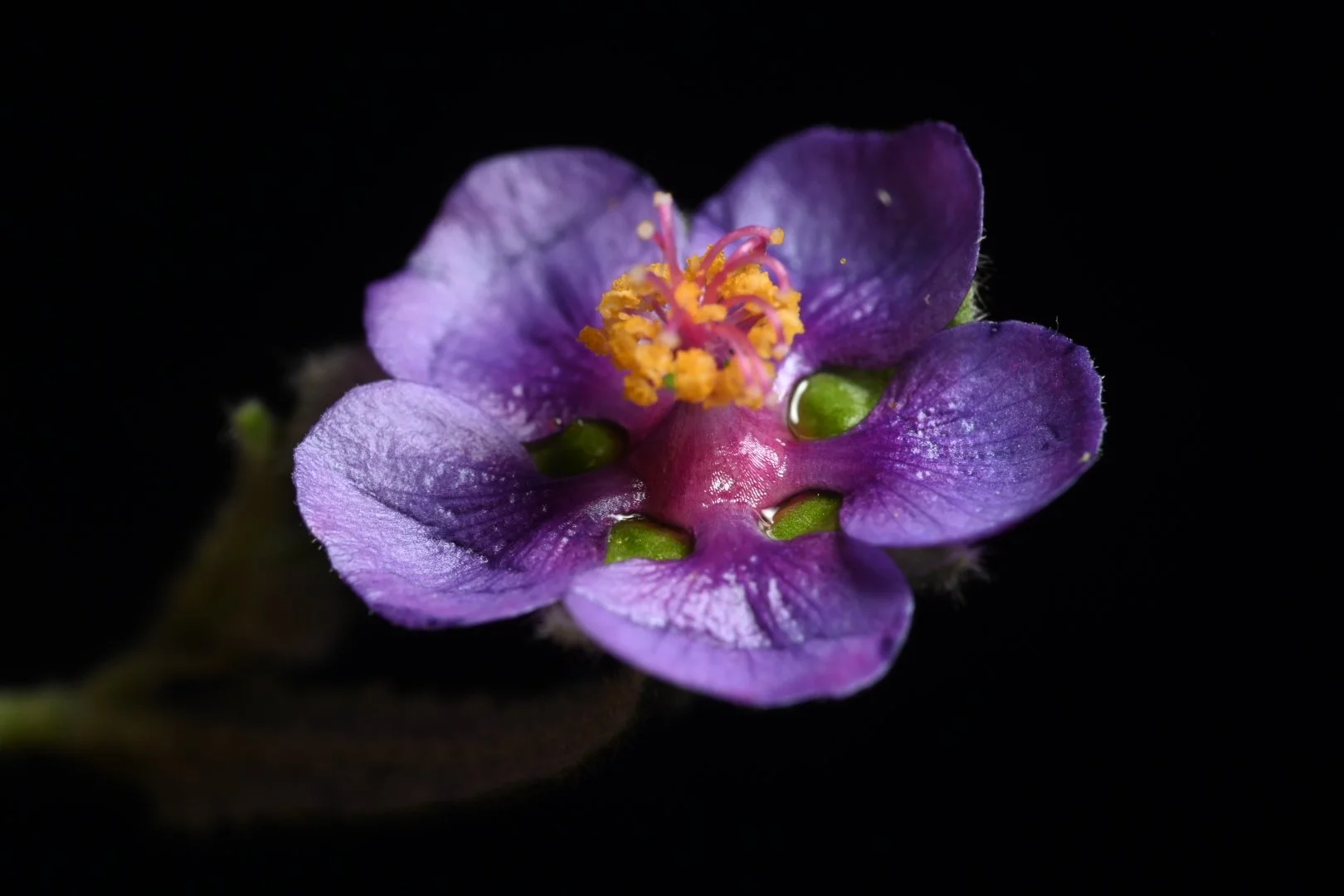
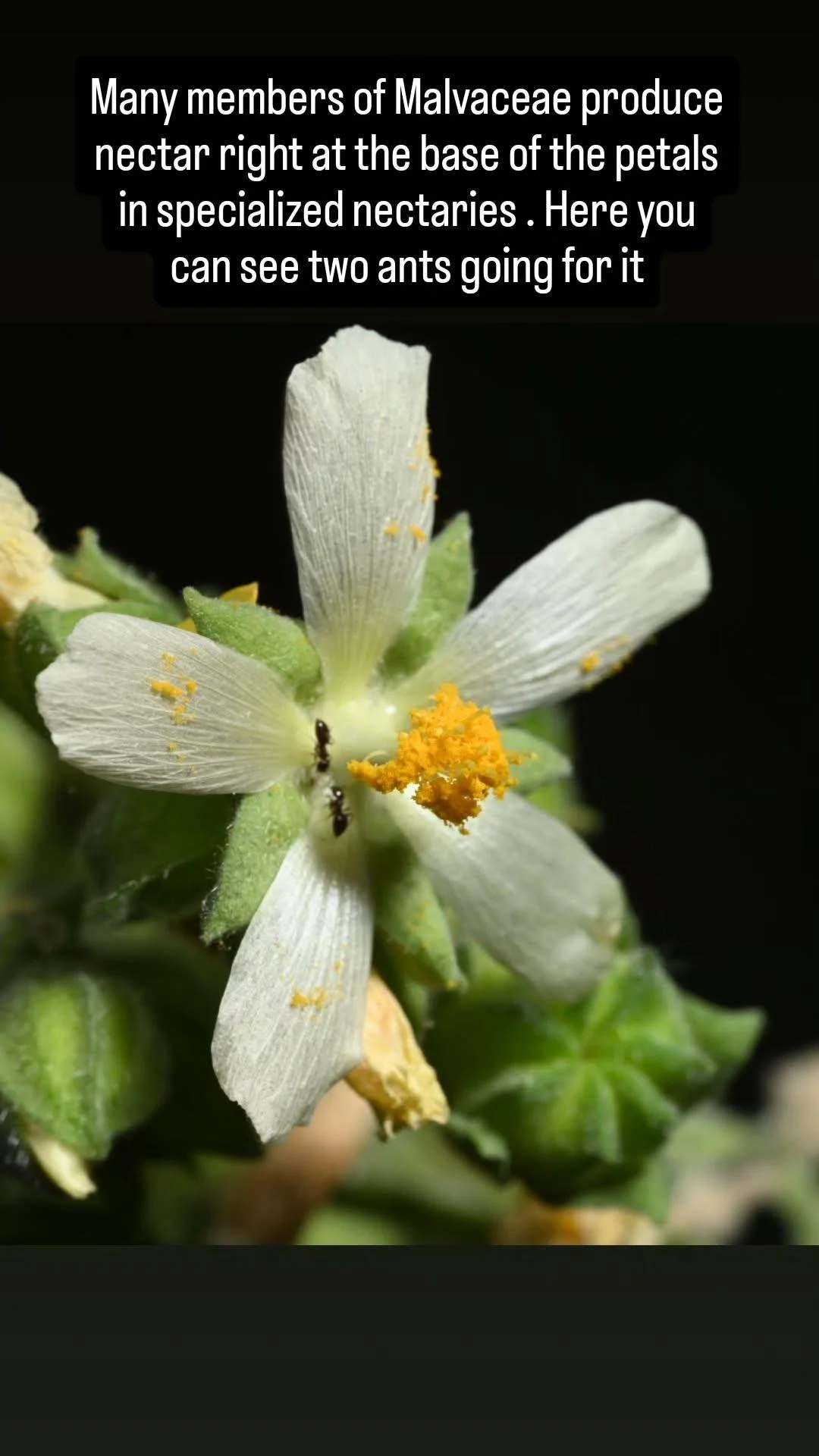
Look at the base of the flowers in this series of photographs - You can literally see nectar glistening at the base of many of them. This nectar is secreted by specialized hairs at the base of the sepals (the layer of floral parts below the petals) termed *trichomatous nectaries*, which is one of the distinguishing factors of the family Malvaceae.
Synapomorphies for a family or genus are a wonderful thing to be aware of, because it shows you how two plant species may be related. Knowing which synapomorphies belong to which family enable you to encounter a plant species that you have never seen before and automatically recognize that it is a member of a certain family or genus, thus helping you further place it and identify it.
Another synapomorphy for this family is the structure in the center of the flower, known as a *staminal column*. You can very clearly see the structure and most members of the genus Hibiscus. It consists of all of the male parts fused together in a hollow tube, while the female part (the style, topped by 5 stigma lobes) rises up through the center of this hollow tube to emerge at the top. If you see this structure in a flower you know it is a member of the Malvaceae.
This is a very important family of plants, not only ecologically to the landscapes they grow on, but economically to humans as well. Chocolate, cotton, balsa, hibiscus, okra and many more food and fiber crops are members of this family.
South Texas Fall Color (Not Really)
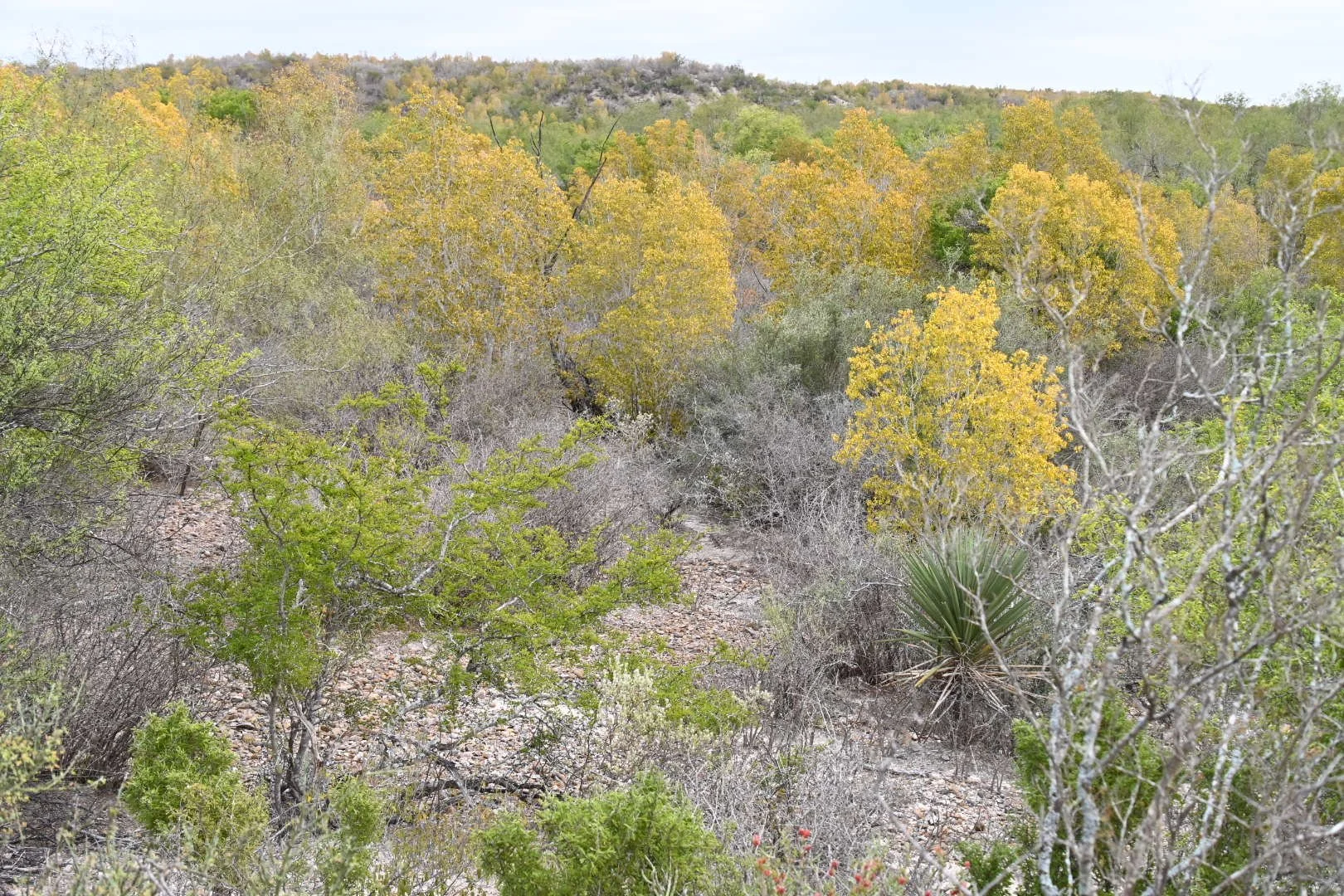
Helietta parvifolia , also known as Beretta, is a hyper-drought tolerant member of the Citrus Family (Rutaceae) that grows in rocky areas of South Texas and Northern Mexico. The leaves turn yellow when drought-stressed, but don't fall off.
When the leaves turn yellow it's because as the plant is entering a state of water stress it js breaking down the chlorophyll molecules and reabsorbing the nutrients they contain, like nitrogen. This "unmasks" the yellow pigments, which are always there but unable to be seen because they are overshadowed by the greener chlorophyll. This is the same thing that plants in colder climates do, except unlike plants in cold climates Helietta doesn't drop its leaves. Abcising a set of leaves and then having to grow them again is calorically very expensive. Much easier to just turn off photosynthesis temporarily but keep the machinery.
When the chlorophyll is reabsorbed, this effectively shuts down photosynthesis, And the plant basically enters a state similar to torpor in animals - a means of conserving resources until the rains come again.
I have a Helietta in my yard and it stays a glistening green all year, as my yard is a much milder and more music environment than these rocky hills and lomas of the South Texas borderla
nds.
The thing is : it's not just Helietta that does this. Plenty of plants from tropical areas with extended dry seasons do this as well. Well there are many plants from the same climate that are drought deciduous, there are also evergreen plants that never drop their leaves but shut down photosynthesis by reabsorbing the chlorophyll and turning yellow.


Mohave Horticultural Failures
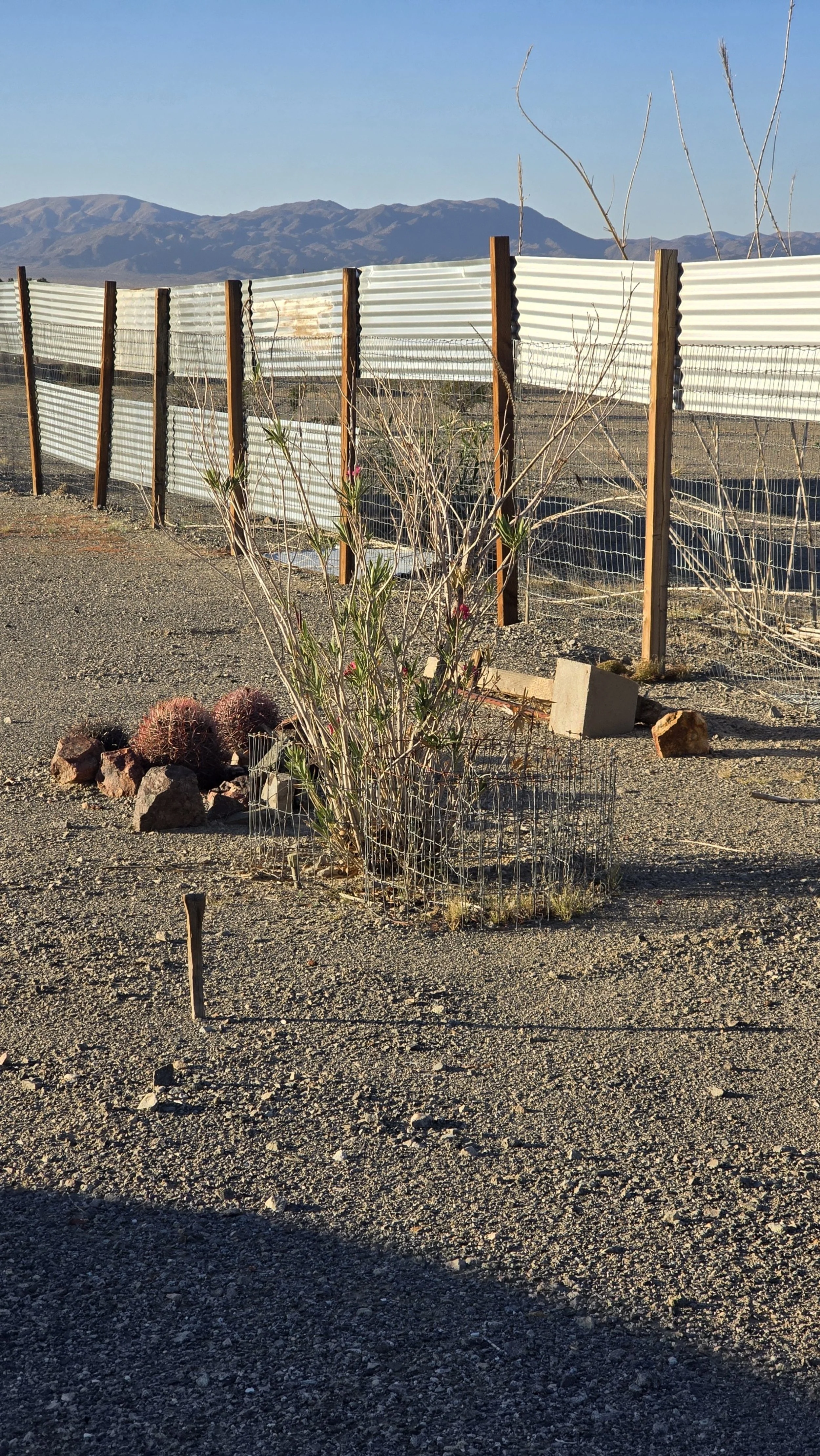
I've seen plenty of people move to the Mojave - especially during the Airbnb boom between 2017-2022 - and try to plant shitty oleander or other horticultural atrocities, and fail miserably. It is just too dry here (average rainfall 4-5", sometimes not even that). There are dead non-native trees everywhere out here, anywhere there is human development.
When you look at the landscape here it begins to make sense : miles of an open ocean of Creosote and the occasional Krameria, maybe a Jojoba or some Desert Lavender (Condea emoryi). Your stupid oleanders never stood a chance. Why should they? They evolved 7,000 miles away.
Luckily there is a large list of really cool plants available that have been built (evolved) to survive the specifically harsh conditions of this desert and the list below is only a fraction of some of them:
Ambrosia salsola - broom-lime shrub that provides good habitat for wildlife.
Asclepias erosa - robust native milkweed to 4-5 ft tall
Ambrosia dumosa - leaves smell incredible
Psorothamnus spinosus - unique shrub that resembles puffs of smoke due to the leafless blue stems
Senna armata - straw-like green shoots that bloom profusely in late fall
Datura wrightii - white trumpet flowers the size of grapefruits that smell incredible and are pollinated by hawk moths
Senegalia greggii - catclaw shrub with flowers that smell like perfume
Peritome arborea - blue leaves and golfball-sized yellow flowers
Condea emoryi - a native lavender with purple flowers that can reach heights of 8'
Pectis papposa - a small annual marigold relative with fragrant leaves
Encelia frutescens - a desert bush "daisy" covered in native bees when it blooms.
Chilopsis linearis (Bignoniaceaw)
Bebbia juncea - (Asteraceae)
But of course - as is too often the case - there is no place for the average schmuck to buy them because none of these plants are viewed as conventionally "attractive" by the bizarre and deranged standards of conventional horticulture, which values things like plants that flower all the time, have varieqated leaves, or can be hedged into neurotic rectangles.
So what is the answer?
We need to change those standards because they make no sense and are discordant with reality. They are rooted in archaic and obsolete 19th century ideas about what plants should look like. We do this not by shaming people but by hyping and embracing all the cool things about these plants : they're sturdy as hell in the extreme conditions they grow in, they support the beneficial insect life that evolved here. That insect life in turn supports the cool animal life that people like having around them, like desert tortoises and birds. These plants resemble the 'nature" and natural areas that attracts people to these regions, they are the living skin of this land - they are the plants that are best-equipped to handle this desert and these extreme conditions. It is illogical to try to plant anything else unless it's a food crop or of some direct and immediate usefulness. You can drive as much irrigation tubing to any of it as you want, it will die because it lacks the drought-tolerance and heat-tolerance strategies that the native plants have evolved, whether it is hairy leaves, waxy leaves, ephemeral roots, storage roots, or controlled leaf drop during drought. This is just about using plants as infrastructure. It is just what makes sense.
Once you start thinking this way, you can take this same outlook and apply it to anywhere, even less extreme, non-desert areas.
The Lovely Florida Scrub & the Brutality of Florida Culture Slums
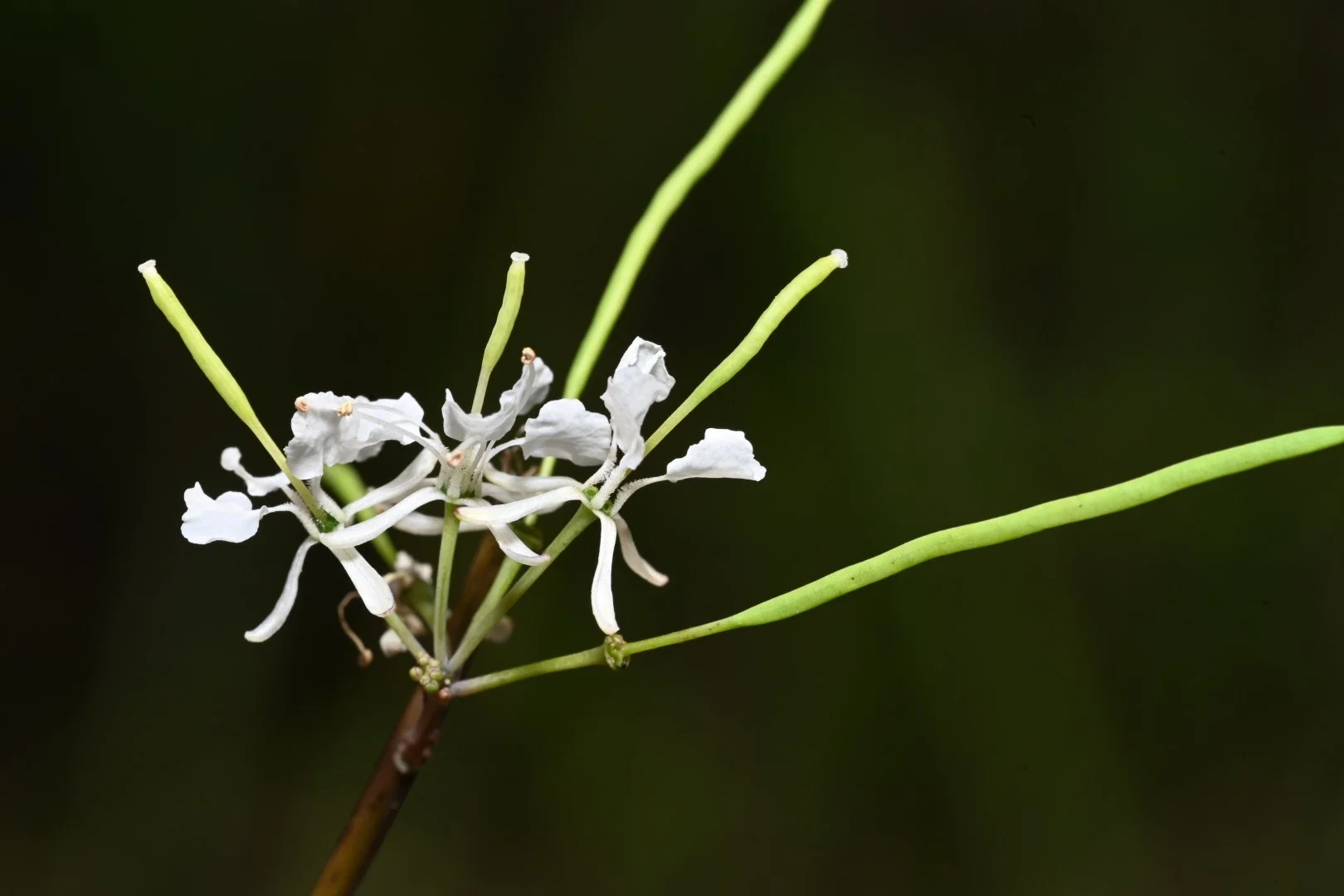
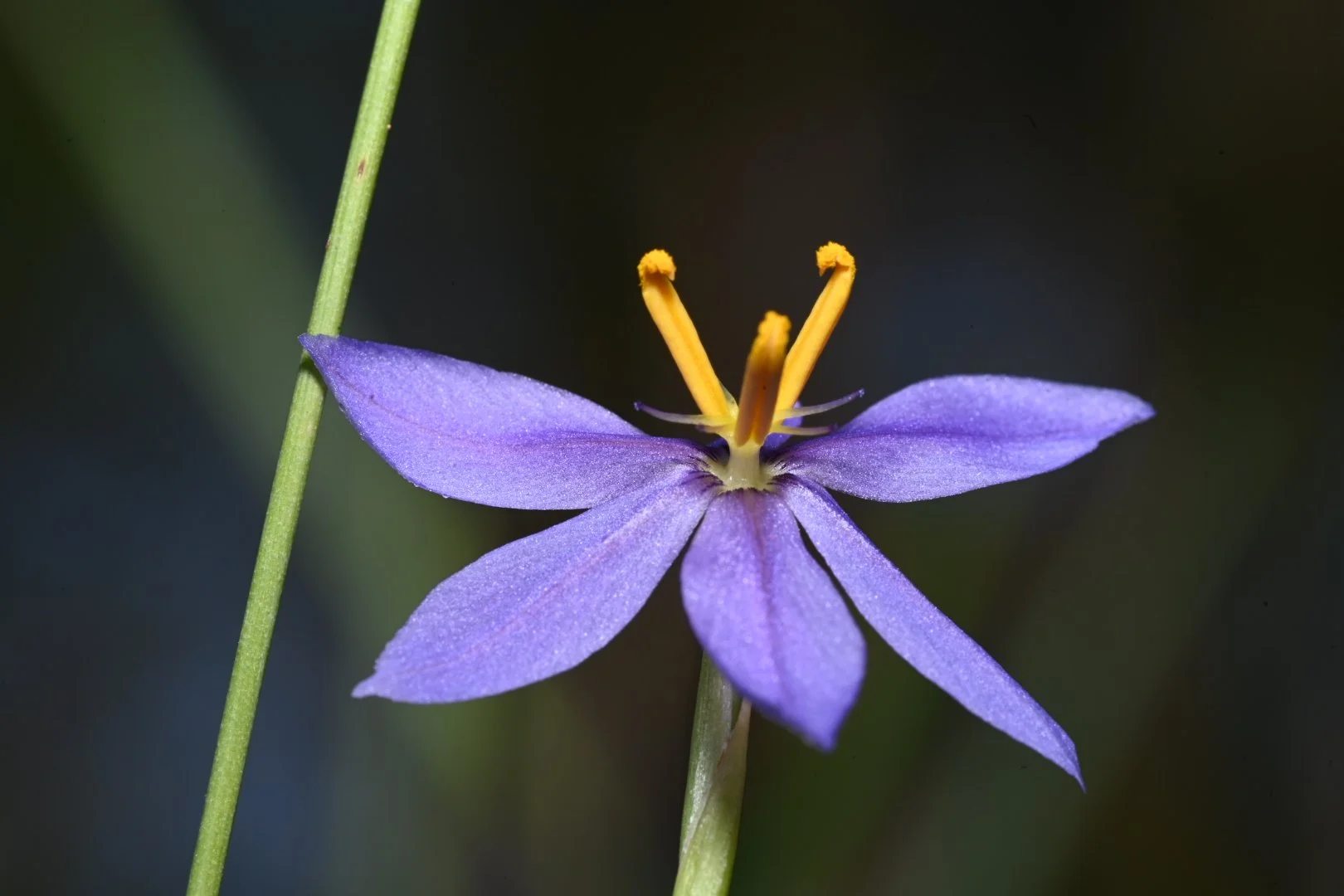
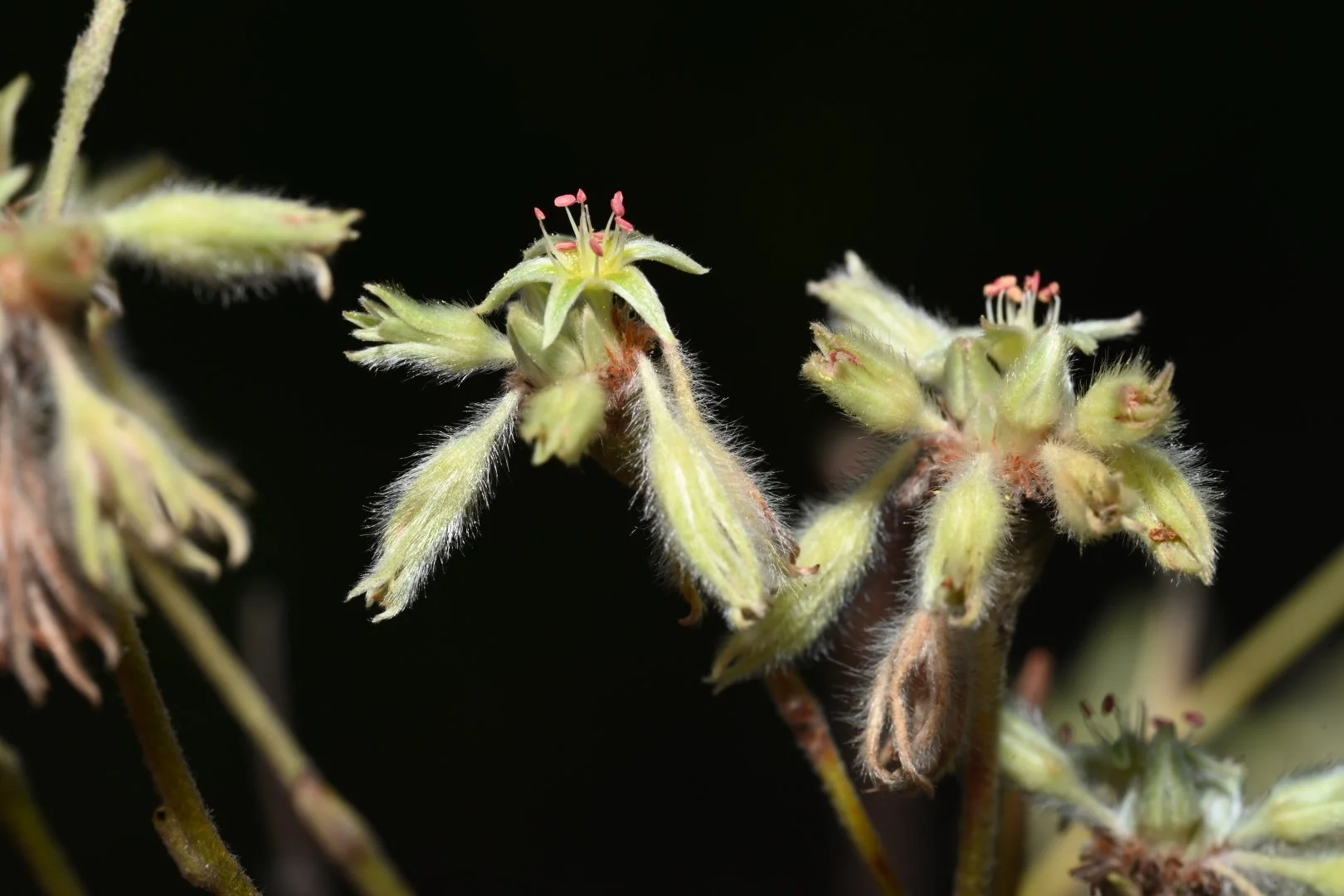
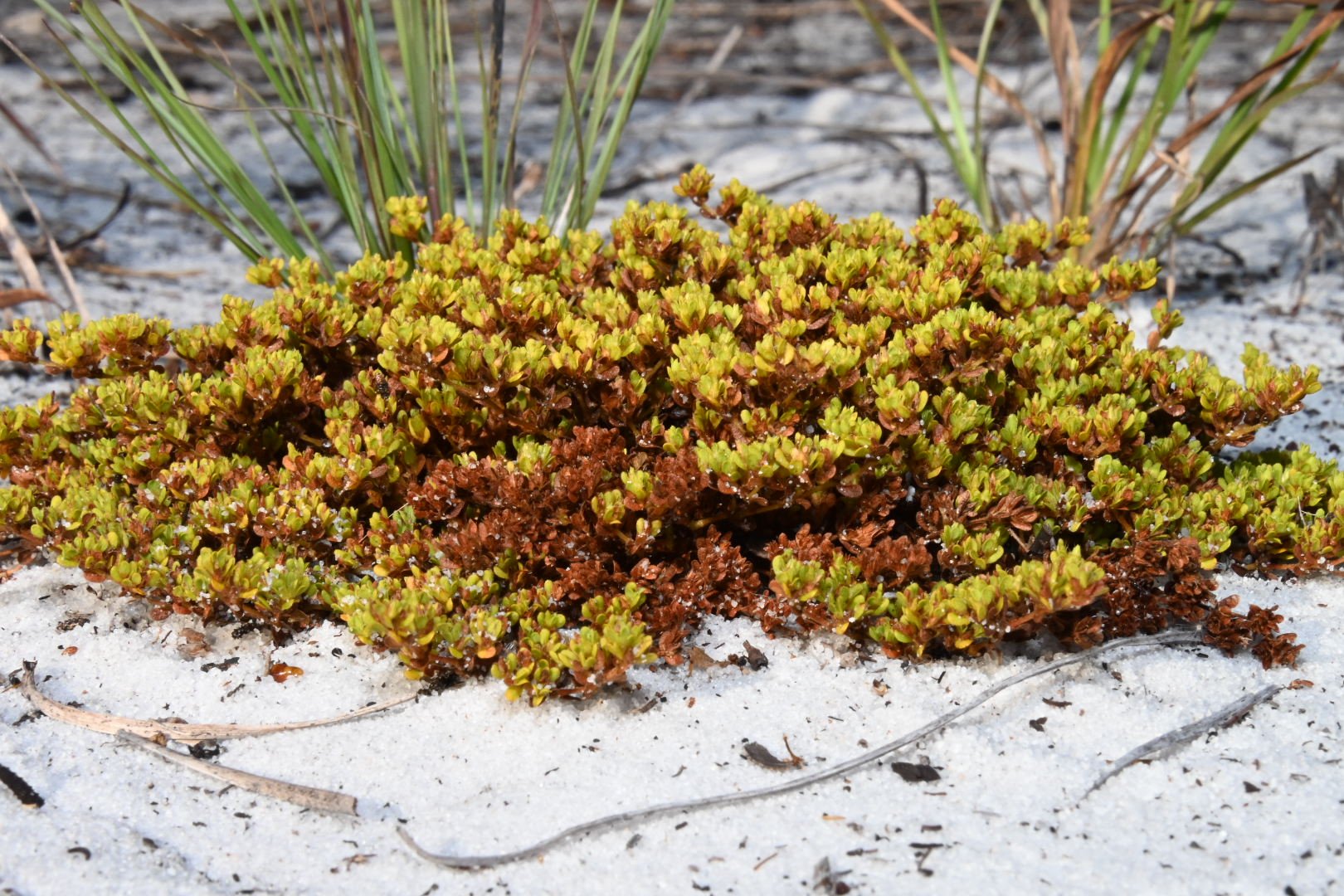
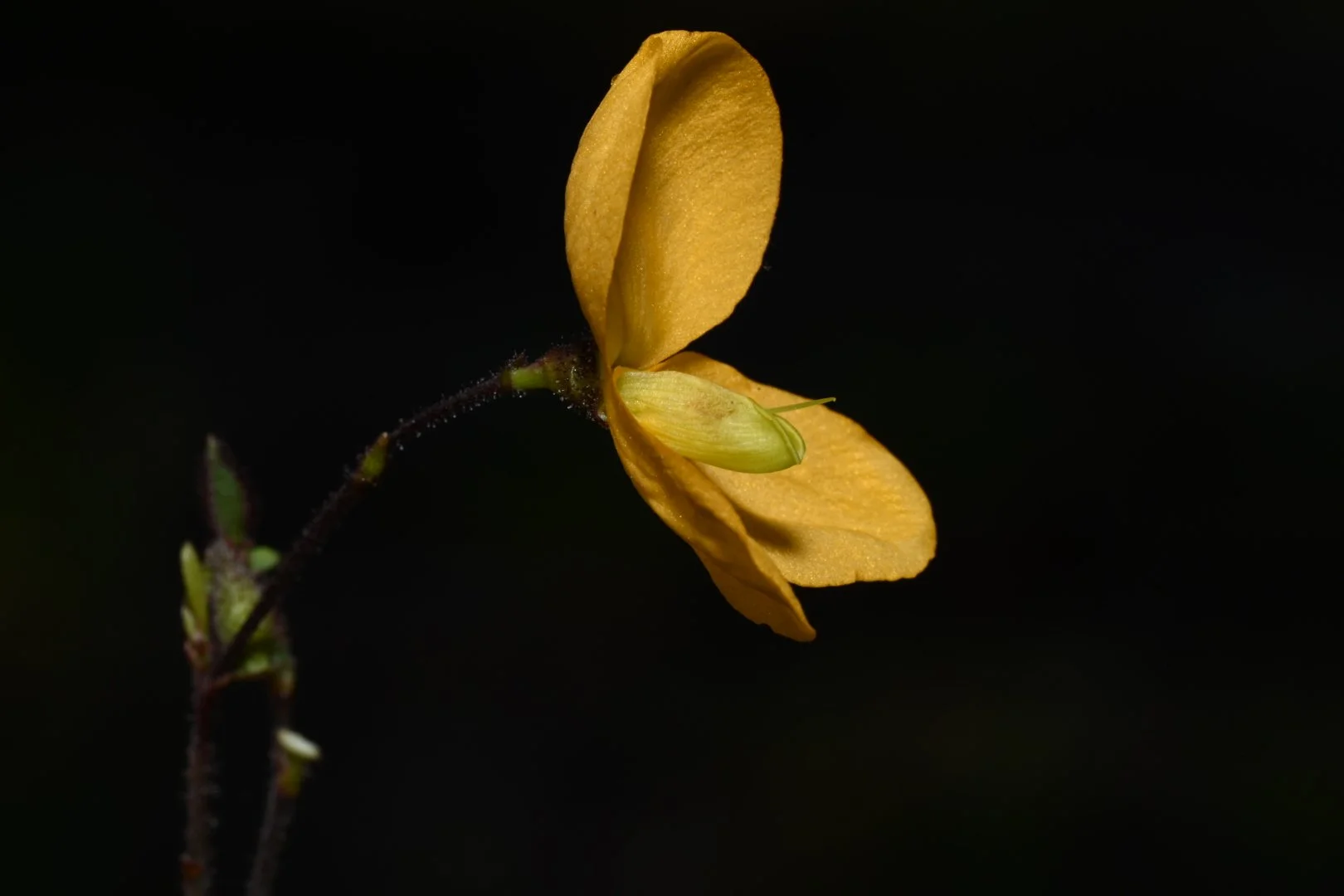
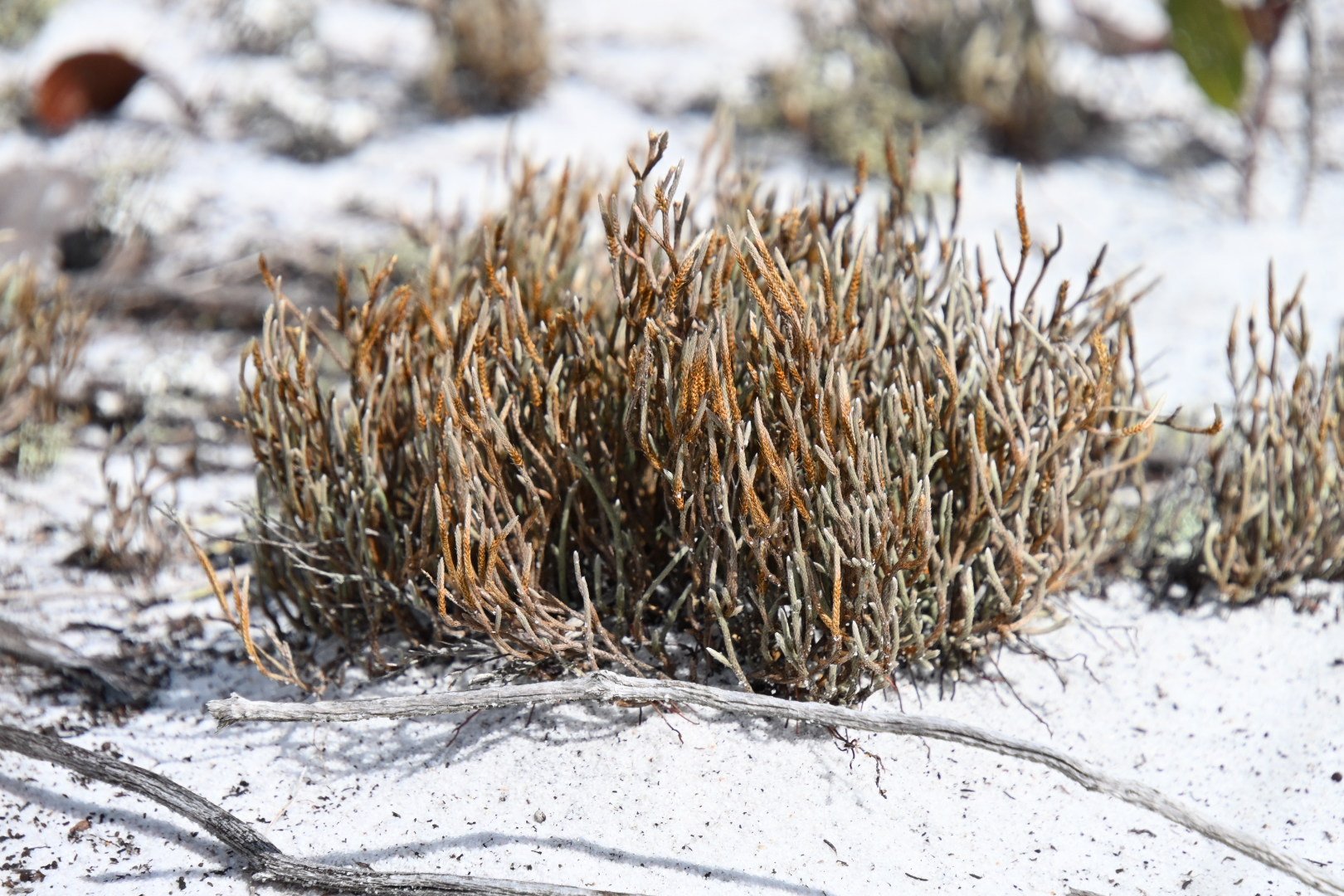
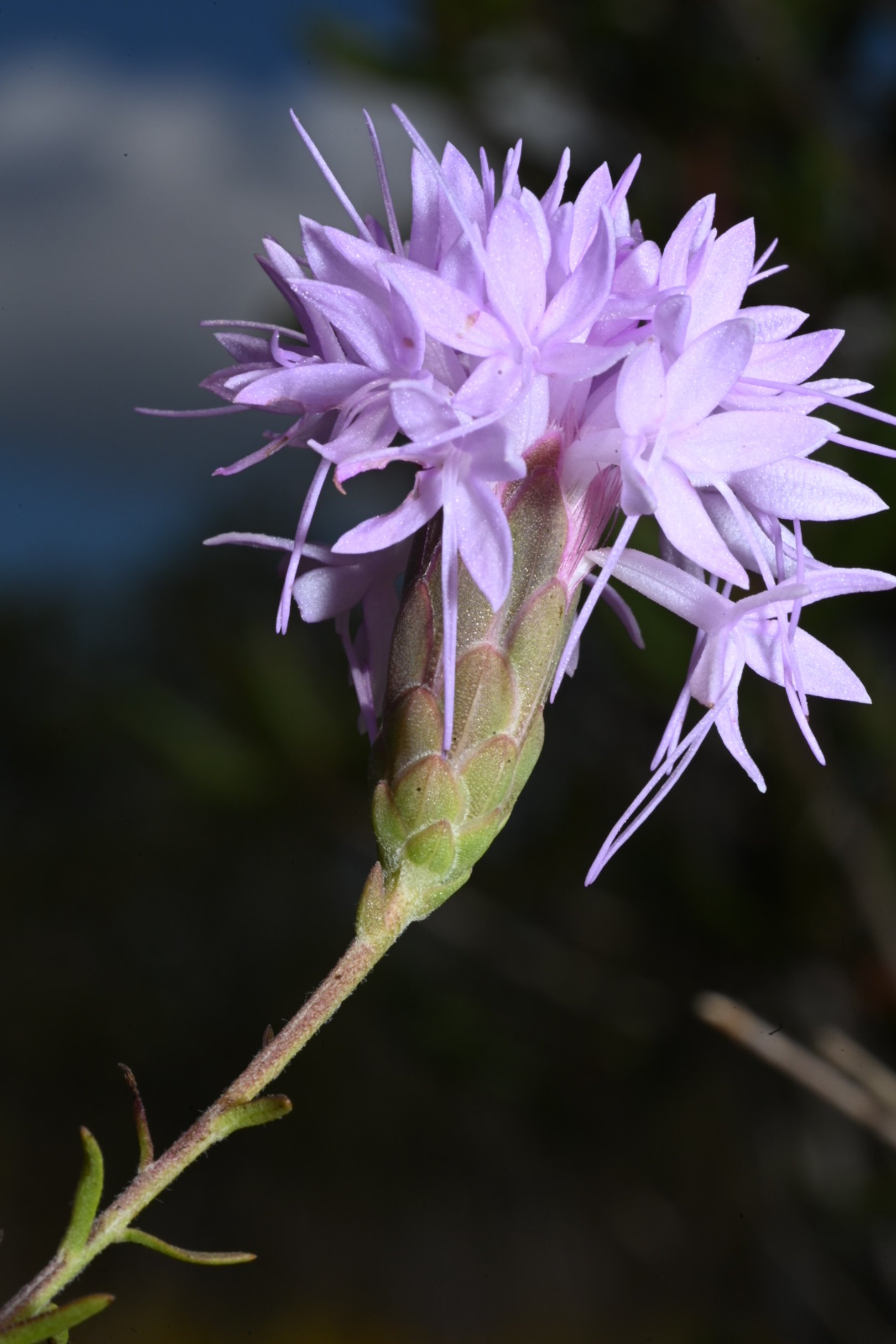
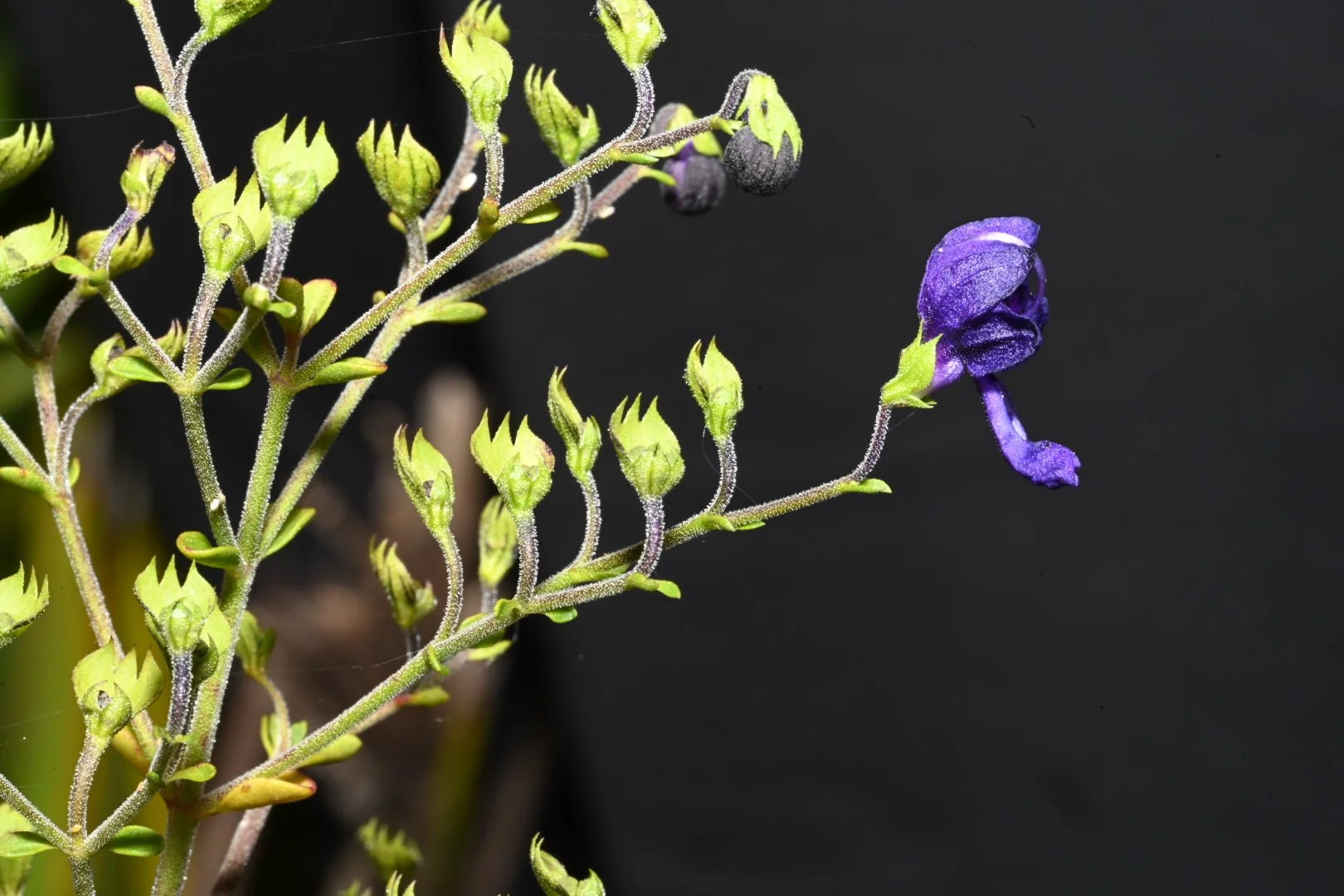
Just finished a week of daily botanizing in central Florida, starting at the Southern end of the Lake Wales Ridge, a 115 mile “spine” of bleached-white “sugar sand” that was one of the only portions of land not inundated under the Atlantic ocean 2 million years ago. It is an extremely rich habitat full of endemic plants that occur nowhere else on Earth. The entire ridge consists of fire-dependent scrub that has historically been subjected to wildfires every 2-5 years - the average annual rainfall is around 60”, but with a pronounced dry season between November thru May. One of the reasons that the area is full of endemics is because of the uniquely stressful and somewhat isolated conditions presented by this spine of sand : the climate is subtropical and the sand is so nutrient-poor that plants are “bred” (via natural selection) by the region itself for adaptability for a suite of stressful conditions not encountered in many other places in the region. Even in mid-October, temperatures at mid-day soared into the low nineties, and the substrate of bright white sand reflected UV radiation and heat back up in our faces as we walked through the scrub communities that were filled with plants such as Serenoa repens (dominant, keystone species), Carya floridana, Pinus densa, Pinus palustris, Pinus clausa, Garberia heterophylla (Asteraceae), numerous species of Polygonella (gracilis, robusta, myriophila, polygama, basiramia), numerous species of Quercus (chapmanii, geminata, minima, elliotii, inopina, pumila, laurifolia), numerous Liatris species (gracilis, chapmanii, tenuifolia, ohlingerae, laevigata, quadriflora) , numerous Andropogon species (cabanisii, capillipes, brachystachyum, tenuispatheum,hirsutius, floridanum), Sorghastrum secundum, Paronychia (herniarioides, patula, chartacea, americana), Balduina angustifolia (Asteraceae), Xymenia americana (Olacaceae) and more. We even saw a presumably naturalized (150 miles North of its Anthropocene-era native range) population of Zamia integrifolia at Archbald Biological Research station.
We also saw a litany of invasives, most notably the dreaded Melinis repens (Poaceae) and Heteropogon contortus (Poaceae). Some of the rarest plants we encountered were Chionanthus pygmaeus, Cyrilla arida, Dicerandra modesta, Dicerandra frutescens, Cartrema floridana.
Numerous ectomychorrizal and saprotrophic mushrooms were present, such as a white Amanita species in section Vaginatae (lacking an annulus and possessing a striate margin to the cap), numerous Boletaceae species, and Ganoderma curtisii, a stalked reishi mushroom that was frequently encountered and mostly-submerged stumps of Quercus geminata and other scrub oak species.
The fire-dependence is visible everywhere, and the ease with which almost all of the plants resprout following a fire (or their seeds germinate post-fire, such as the fire-dependent Ceratiola ericoides) is testament to the long history of fire in this region. Many of the plants in this region produce Xylopodia - underground storage lignotubers that enable them to immediately respond to fire with bursts of new growth, taking advantage of the “cleansing” the fire has afforded the habitat and the lack of competition.
It feels incredible to spend a week getting to know a landscape so well, spending upwards of 8 hours a day sweating in the sun taking photographs and memorizing the names of new plants, studying the ecology firsthand, looking for clues in the landscape that allude to the behaviors of the plants and the organisms that exist with them.
The human culture of the region is some of the most vile and repulsive that I have experienced anywhere in the US : money-worshipping buffoons happy to destroy museums of evolutionary masterpieces and intricate living machines of ecosystems for the sake of erecting some of the most repugnant and idiotic infrastructure known to modern humanity. It is the equivalent of demolishing the Louvre or the Smithosonian in order to build a stripmall housing a dollar general, a payday loan store and a pawn shop. After spending fifteen minutes in Orlando traffic in some of the most hideous scenery that man has created, I understood - for the first time in my life - how some people (mostly males) are driven to commit mass shootings. Of course, this is not to say I condone such behavior or empathize with it, but I can see how years of living in such a condition could make someone so short-sighted and oblivious to the scale of suffering they were inflicting on others, and how such a lifestyle to lower a human being into such a depraved state so as to feel motivated to commit such an\ terrible act. The “communities” (they are anything but) that exist that so much of the wonderful habitat that I just spent a week diving into consist of long traffic jams of alienated, miserable people who all hate each other and have no connection to the living world around them - apes that evolved (as we all did) to spend time interacting with living things and moving through a living green skin that are not instead locked inside soulless concrete and carpeted storage containers that seem like nothing more than pampered versions of prisons. Nowhere is walking or biking permitted without the threat of death, and one must be trapped in a car at all times if transport of any kind is required.





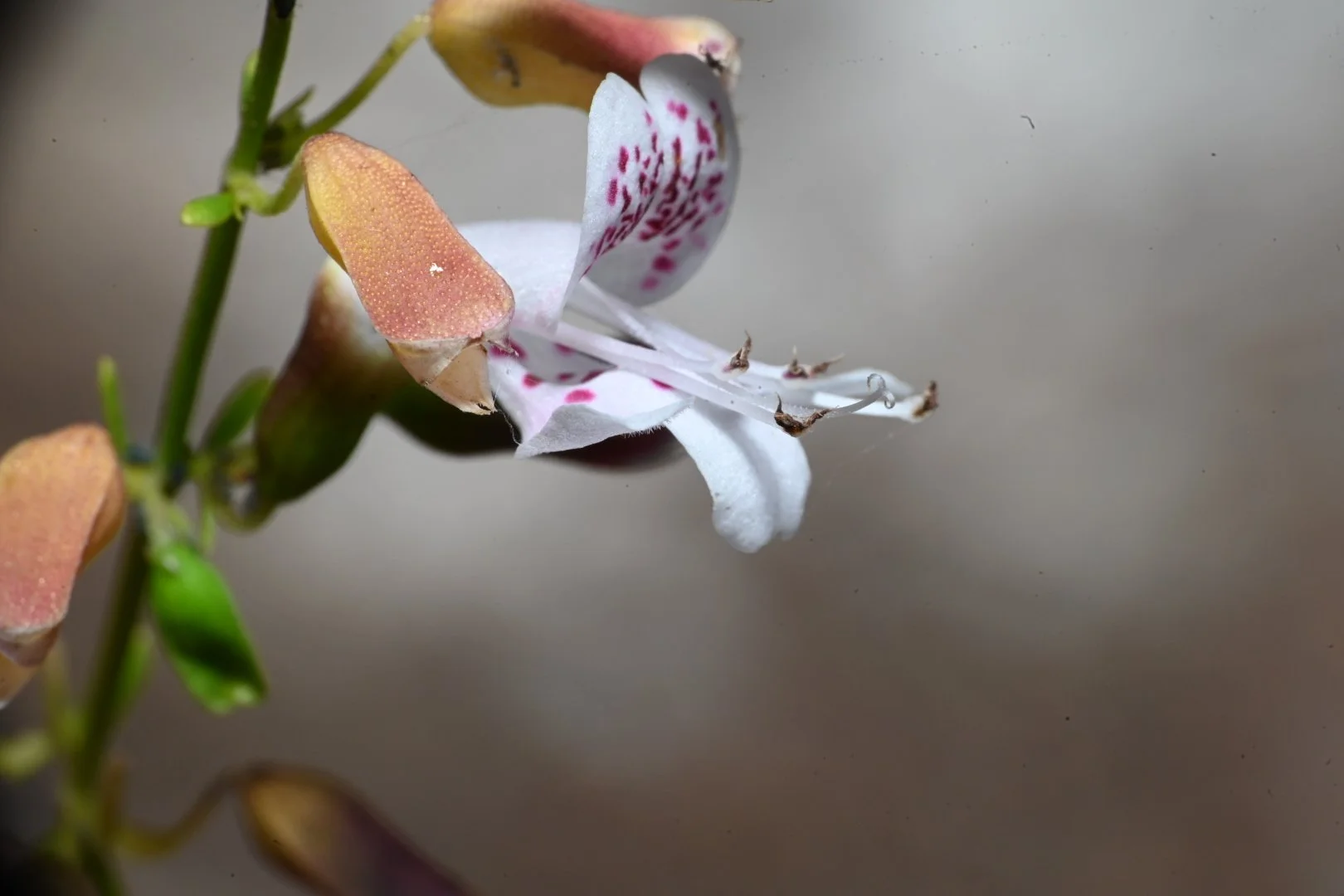
INVASION BIOLOGY DENIALIST TAKE-DOWN #376
With every passing shitty social media post, deniers of invasion biology continue to become the ideological equivalent of creationists, with skulls too thick to be able to make their empathetic and compassionate versions of the world mesh with the reality of both evolution, natural selection, ecology and the native distribution of living things prior to human trans-oceanic travel. I don’t necessarily fault them for it - to understand why some things are invasive and others not requires a much broader perspective on the world that an 80-year human lifespan does not innately afford us.
This topic encompasses the very broad fields of biogeography and speciation itself. There are textbooks on both biogeography and evolution. Carl Zimmer's textbook on evolution is a great place to start. Species evolve as members of ecosystems, each species has its own series of checks and balances. For plant species those checks and balances come in the form of fungi and insects. Millions of years of an evolutionary arms race exist between a plant species and any antagonistic fungal or insect species. If the plant species doesn't go extinct altogether it eventually evolves resistance, as happened with Chinese chestnuts and the chestnut blight. The adaptation of Chinese chestnuts to chestnut blight took millions of years and many intermediate steps of pathogenicity and resistance.
The result of those millions of years of an evolutionary arms race was that Chestnut blight is only a mild pathogen to Chinese chestnuts. When that flight was brought across an ocean that it could never have crossed on its own, and that a spore could never have been blown across because the oceans are fucking 3,000 miles wide, It found a new host that had no resistance because it had not spent millions of years evolving in the same ecosystem. So what happened? American chestnuts became functionally extinct within 50 years.
The same case has repeated itself, although maybe not to the same degree, hundreds of times in the last century or two due to human assisted dispersal across oceans of plant, vertebrate, insect and fungus species
Kudzu is not invasive in Japan because there are numerous insects and fungi that prevent it from becoming so. As a result it is a very important plant species there, and helps keep the biosphere intact. Bring that kudzu to a new continent where the checks and balances don't exist however, and it smothers entire ecosystems. Will something eventually evolve in North America to keep kudzu in check? Absolutely, but in the 5,000 to 50,000 years that might take how many plants species will go extinct and how many habitats will be smothered and at what point will the entire ecosystem collapse, and will that happen before something evolves to control kudzu? Maybe.
The worst invasive species tend to be very important pioneer (the fact that this word is italicized and highlighted in bold should imply to you how important an understanding of it is) on other continents - and indeed some of our most valuable native pioneer species like Verbesina encelioides, Acer negundo, Robinia and Solidago sp. are highly invasive on other continents. The entire process of ecological succession is immensely important towards understanding not only why some plants are invasive but how eosystems on planet Earth heal from disturbance events such as landslides, floods, wildfires, or most commonly - bulldozing and land clearance by humans. Pioneer species are primary successional plants that are the first to move in after disturbance. They re-colonize barren ground very quickly, tend to grow fast, produce a shit-ton of seeds, and are generally short lived. Along the way, they provide cirtical services to the ecosystem, such as shading the ground and creating a microclimate of humidity and cooler temperatures, their roots infiltrating the soil and providing vital scofflding for beneficial microbes. They basically “prep” the land for the slower-growing, longer-lived species that can only get established once conditions on the ground have improved enough after a disturbance event.
Pioneer species are immensely important to ecosystems where they are native - where they spent millions of years evolving relationships with other plant, insect, fungal and vertebrate species that they grow sympatrically with. No species is an autonomous entity, existing by itself in a vacuum, but a critical member of a much larger functioning system full of a multitude of other species with which it has spent exponentially long amounts of time evolving relationships with. Those relationships can be mutualistic or antagonistic. Each species is a “gear in the machine” - the living machine - that is the biosphere. Likewise, humans can be mutualists for many species, rather than antagonists - as we so often are when clear massive swaths of land for agriculture or because we think plants look “messy”, or when unthinkingly establish plant species from other continents without considering the ecological behavior of those species and whether or not they might behave invasively and aggressively in their new habitats.
Why do some people think invasion biology is nonsense? Most likely it is because they have a perspective that has not "zoomed out" far enough, not only spatially but temporally, And also because the field of ecology and evolution are only a century and a half old, and it is something that most of us are not taught nor do we encounter in our very brief and short human lives.
FURTHER READING : Any Biogeography textbook. THE ECOLOGY OF PLANTS (3rd edition) by Gurevitch (it was once available on libgen, which has now shutdown, but might be available on Anna’s Archive. EVOLUTION : MAKING SENSE OF LIFE by Carl Zimmer. RAVEN BIOLOGY OF PLANTS (8th edition).
Why you can’t grow cool-climate plants in hot climates
Since moving to Deep South Texas 4 years ago I've come to realize that many plants I used to love growing in the cool mild maritime climate of the SF bay area are impossible to grow where I live. This is not just because of the high daytime heat. It's not as simple as that. Specifically, it is the high heat during the night (and those warm nights are a direct result of the humidity) that causes cool-climate and cool-season plants to eventually die here. That's a bummer for somebody who loves plants from places like cloud forests of Central America, the Páramo of Ecuador, Alpine plants from the Rockies or Southern Andes, etc. This phenomenon is also quite fascinating however, and goes far to explain why growing certain plant species or even entire clades (evolutionary groups) of plants is so impossible outdoors in certain climates. It all has to do with metabolism and something called compensation point.
Like animals, plants respire. This means they burn sugars to create new tissue as well as the chemical compounds they use to defend themselves against fungi & insects, as well as simply to conduct daily metabolic processes required for survival.
“Compensation Point” refers to the light intensity or CO₂ concentration at which the rate of photosynthesis exactly equals the rate of respiration in a plant. At this point, there is no net gain or loss of carbon—the CO₂ absorbed during photosynthesis is equal to the CO₂ released during respiration, and the oxygen produced matches the oxygen consumed.
For a plant to grow (not just survive), it must operate above its compensation point. It must produce more than it consumes. That is, photosynthesis must exceed respiration enough to generate a net gain of carbon to -create new tissues
- put some energy in storage reserves in the form of starch and sugar
-produce defense chemicals (alkaloids, toxins, etc) and mechanical defense (spines, thorns, hairs, wax)
- produce reproductive tissues like pollen, nectar, flowers and fruits/seeds
Below the compensation point, and operating at a carbon deficit, the plant burns stored energy reserves and eventually dies. Along the way it will decline in health and will gradually become weaker and more prone to insect infestations and fungi.
What do warm nights do to cool season plants and why?
Respiration (which burns sugars for energy) increases exponentially with temperature (roughly doubling every 10°C rise). Essentially what this means is that plant metabolism is dependent on temperature, something I've repeated many times in videos. In areas where the nights remain warm (because the air is humid and contains water vapor…which is slow to let go of heat), the plant’s metabolism will run at an accelerated rate at night.
So essentially, warm nights mean the plant burns more stored carbohydrates (sugars, starch) just to maintain basic metabolism. This leads to a reduced net carbon gain in a cool-season or cool-climate plant that has spent the past few million years evolving in a place like the Páramo of Central America, or the high Andes, or the rocky mountains. As we stated before, the plant eventually dies, and it is probably a long protracted death along the way, where the plant might be infected by scale and mealy bugs and not have the metabolic energy to produce defenses against them.
A similar case exists with Tomatoes : Hot nights (>75°F / 24°C) cause excessive respiration, burning through the day’s limited photosynthetic gains. Even worse, high humidity reduces transpirational cooling, since the air is not as readily pulling moisture out of leaf stomata. This only raises leaf temps further. Why do tomatoes have this limitations and why do they behave this way? When we look at where the wild ancestors of tomatoes evolved, it starts to make sense.
The wild ancestors of tomatoes - a number of species such as Solanum pennellii, Solanum peruvianum, Solanum chilense, and Solanum pimpinellifolium - are native to very high elevations above 8,000’ in the Northern Andes, near the Peru-Chile Border. They grow in a climate unlike any that can be found in North America - namely high, dry elevations at low latitudes (18° South) - this means they are exposed to cooler temperatures (because of the elevation) than one might think they would tolerate at such a low latitude, while still being hit with a very intense amount of solar radiation and light (which they not only tolerate, but need. Tomatoes are full-sun plants, as most people know). I encountered Solanum pennellii growing in a drainage sandwiched between rocky, almost barren slopes that were dotted with massive Browningia candelaris cacti at 8,000’ (2440 meters) in Northern Chile. It was remarkable to see these little herbs - their leaves were covered in glandular trichomes (sticky hairs) that looked and smelled just like those of modern tomatoes. The ancestry was obvious.
But it is not just warm nights that cause certain plants to decline. If some plants do not get enough light, this also affects the compensation point. They are not able to produce enough carbohydrates via photosynthesis to create the defensive compounds they need nor the reproductive structures (which are highly metabolically costly) they need to reproduce and produce fruits and seeds.
This reminds me of a question I got a month ago from someone who had a cactus for 4 years that they were growing on a partially shaded window sill. They moved apartments and when they arrived at their new place, they put the plant in a sunny south-facing bay window which got light from above as well as from the side. Within a week or two the cactus bloomed. When the plant was placed in a location where it got more light, it exceeded its compensation point and since the plant was now producing an abundant amount of carbohydrates compared to the paucity of them that it was producing before, it was now able to devote some of that energy to the production of flowers.
The case with compensation point and the struggle of trying to grow cool climate plants in very hot humid environments is exactly the opposite for tropical plants and warm-climate cacti (Note that many high Andean cacti from South America operate at cooler temperatures than most Mexican cacti)... When hot-climate plants are attempted to be grown in temperatures that only reach the high 70s at most, their metabolism drastically slows down and they are not able to produce chemicals to defend themselves nor especially to produce new tissue and new growth.
Further, different plants have evolved their own variations of the photosynthetic process in order to cope with some of the extremes in the regions where they are native. Specifically, CAM photosynthetis, C3 photosynthesis and C4 photosynthesis are issues at play here.
In cacti from warm climates especially, CAM photosynthesis does not operate very efficiently below 85° f. CAM photosynthesis is a process whereby plants open their stomata and take in CO2 at night - when temperatures are much cooler - to avoid releasing too much H20 through those same stomata. CAM plants absorb CO2 at night and store it in the form of malic acid to be used for photosynthesis during the day when the sun is out and light can power the photosynthetic process.
Also playing a role in all of this are C3 and C4 photosynthesis. We won’t get into this now, except to say that C4 photosynthesis is far more efficient at hot temperatures (thus why many plants - especially hot-season grasses - from warm climates use it. They do this with the help of something they evolved called “Kranz Anatomy”, and Kranz Anatomy has evolved independently in plants many different times throughout history) and C3 photosynthesis is more efficient at cooler, milder temperatures. Whether C3 or C4 photosynthesis is more efficient - and why it evolved in the first place - has to do with a negative phenomenon called photorespiration. In short, photorespiration is the process whereby an essential photosynthetic enzyme called Rubisco. Rubisco is the most abundant enzyme on Earth and is supposed to fix CO₂ into sugars. At high temperatures, however, Rubisco bonds with oxygen, instead, which produces a toxic byproduct (phosphoglycolate) instead of sugars. Rubisco’s affinity for oxygen at high temperatures is its flaw, and some think that since Rubisco evolved 3 billion years ago, when O2 levels were low and CO2 levels were high, its affinity for oxygen wasn’t a flaw until “recently” (speaking in terms of the geologic time scale, of course.
Overall, compensation point and a plant’s ability to grow in a given climate is a balance between the light available, the carbon dioxide available, and the temperature (and how it corresponds to the plant’s metabolism, which is dependent primarily on what kind of climate it evolved in over the past few million years.
Being Taught to Think
One of the biggest tragedies of the American education system is that it teaches memorization rather than critical thinking. “Critical thinking” as a phrase is almost a cliche. It gets repeated all the time in the popular lexicon, sometimes by people who don’t really seem to understand what it means. What does “critical thinking” mean? Teaching someone to think critically is basically giving them the tools for self-learning, which is part of why it is so empowering. Rather than accepting things at face value and simply memorize them, learning critical thinking teaches you to ask “what the shit does this mean exactly” and “you might say a given idea is the case, but why?”- questions like this are as fundamental to science as they are to philosophy. Learning to think this way is what helped me teach myself botany, geology, grasp a semi-coherent understanding of natural selection and evolutionary biology, as well as how to screenprint efficiently, change my goddamned oil, and install light fixtures.
The American education system in most regions - not surprisingly - does not teach critical thinking. Teaching people not only to question but what questions to ask dangerously empowers them, threatening the power structures that enable those at the top to continue sociopathically hoarding wealth, convinced of their own superiority. Memorization isn’t learning - memorization for the sake of passing a test and getting a grade is not a metric of an intelligent mind nor a metric of a healthy education system.
As a kid with horrible ADHD, boredom and an inability to focus unless I was receiving some kind of dopamine drip from the subject material, I hated school. Emphasis was put on passing tests, rather than finding passion or inspiration in the material. The emphasis was never on broadening one’s perspective, or on “zooming out” and connecting the dots between cause-and-effect, or a chain of reactions between different entities. I suspect little has improved in the education system, especially with the advent of attention-sucking, distractive smart phones which must fuck up a child’s psychology greater than anything else.
I mention this because people will often write me asking for books to read to learn botany. I always repeat the same thing : Plant Systematics by Michael Simpson, Raven’s Biology of Plants, and Evolution: Making Sense of Life by Carl Zimmer, but then I follow up with : Books are not the way to learn botany, or any science really. A person can have a library full of books and memorize all of it and still be a shitty botanist. Reading books alone is not the method to learn botany nor should emphasis be placed on it, as if information simply transfers from the page to the human brain via osmosis. ASKING QUESTIONS is the key to learning anything. Going out into the field, having the subject material (plants, or rocks, or bugs, or soil) in front of you and actively thinking about it, asking questions and then trying to answer those questions is the way to learn anything. Figuring out what questions to ask requires thinking, and there in lies the exercise which makes the mind stronger.
With one’s own children, it is standard fare to teach memorization and obedience, not critical thought. I disagree with this method. Obedience is not a virtue, if anything it can be a hazard. Teaching a child to question, to think, to ask why a rule might exist and what its purpose might be - that is what builds strong, intelligent and capable adult humans. Some rules exist for good reasons, some are bullshit, some are not based in ethics, morality or the avoidance of hazards at all and are merely only the wishes of the person who declared the rule to be a rule in the first place. If the rule is not unreasonable and following it would not offer any risk of harm, it should be followed just as a matter of common decency and respect every human being is deserving of, no more and no less.
I didn’t learn to question things ideologically or philosophically until I turned 13. I didn’t learn to question things scientifically until I was twice that age or older. I only wish I had been taught both in grade school.
Like putting a pill inside a hot dog in order to give a dog life-saving medicine…
Some of the only times that I feel hopeful about humanity is when I see individuals venerating and forming relationships with plants, and with specific plant species. It is when I see them coming to form relationships with specific plant species as if they were old friends. The dopamine hits I get from sharing things that I love and respect with people, and watching them learn to love and respect them, too, is addictive. Social media is generally a toilet, a place for the lonely, isolated and miserable (and aren’t most of us) to go to escape what is for most of us a very unfulfilling, depressing reality. If one or two good things can come from it, let it be the awareness of “the real world” - the world outside of human society and our make-believe world of human meaning and anthropocentrism, which is wholly disconnected from the biological and ecological reality of life on Earth.
If the act of bringing people to plants - of recruiting them to the causes of plants - means initially showing people how a plant species may be edible or useful, I only do it in hopes of it one day opening the door to them later coming to see the bigger picture, learning to zoom out, taking a more long-term and broader perspective of humanity’s place in the context of the web of life, geologic time, respect for the living machine that sustains us. It is my hope that eventually that respect turns into active cultivation and stewardship, whether it’s killing lawns, collecting and spreading seeds, planting native plant gardens, illegally planting native plants, creating habitat for life, sustaining the living machine, the living organism of life on Earth. Humans do not need to be a destructive species, that is only our unthinking, uncultivated self - the chimp running mindlessly through the forest tearing up anything that it comes into contact with and fighting with other groups of chimps intent on doing the same thing. We can be so much more than that, but it takes intellectual cultivation, self-awareness and active participation in the living world around us. It requires stepping outside of ourselves and our own psyches, it requires self-examination, and more importantly it requires examination of the living world around us.
Plants Vs. Marriage
I was at the conservation property recently with a friend, telling her my views on marriage and how I repeatedly state, only half-joking, that marriage should be banned. “Why get the government involved in a personal relationship?”, I said. “Why needlessly complicate a relationship you have with someone should you ever fall out of love with them or have a falling out? I love my friend Javier, he’s like a friggin’ brother to me, but I don’t feel the need to make our friendship official or recognized by law. That would be the worst possible thing we could do, if it were even possible. It’d be like turning our friendship into a contract, a work obligation. Should either one of us grow apart for whatever reason decades down the line, then we’d have to get a bunch of sleazebag family law attorneys, pay them up the ass, worry about one person ripping the other off for half their worth, etc. Further, it’d be entirely unnecessary. For this reason, I also know that my friendship with Javier will far outlast most marriages.”. Similarly, I have friends that are in romantic relationships with each other that have been together for decades and never got married. They hate marriage. Their relationship seems more durable, impervious to strife and born outta genuine love simply because of the fact that they’re not married : both are free to leave at any time. Neither is nailed – down by law – to something that they’re not otherwise fully committed to.
My friend told me that she realized she didn’t want to be married anymore when she was talking to her shrink. She had “fallen outta love” – whatever romantic “love” even means to most people in the first place is beyond me, I’m highly suspicious of their definition of it to begin with – with the guy a year before but wasn’t sure yet if it was real or what it meant. Her therapist asked her what scared her the most, what prevented her from ending it. She replied “being 65 and alone” (sounds like a dream to me, tbh). “Ok, let’s go there” her therapist replied.
So my friend closed her eyes, she told me, and imagined herself at age 65, alone, and what it would be like. She immediately thought of herself sitting down outside, on the ground, surrounded by plants that she was interacting with, either observing them or planting them or collecting seeds or something, she didn’t really know, it was just a daydream. At that moment, however, she realized that in the image she had of herself at that age that she was not, in fact, alone. She was surrounded by the plants, and the plants had a spirit. They are alive and respiring and photosynthesizing and she could feel them. “You felt surrounded and embedded into the living world.” I told her. She started crying as she told me this. She looked at the peyotes in the ground and told me how the peyote, more than anything – perhaps because of all the spirit and love that native people put towards it – embodied this connection with the living world for her. The peyote had a spirit, she said, and it made her feel held and cared for, nurtured, loved. In return, she reciprocated that love to it, and to every other element of the living world that she interacted with.
That, to me, is a genuine love far more enduring and lasting than the love you might find in most marriages.
High hopes for the thornscrub
I’m excited to tend to Thornscrub like I would my own yard (I hesitate to use the word “garden”, it sounds vanilla as hell and too safe, manicured and wholesome). Thornscrub will have elements of the living world that I could never have in my own little yard, which still has to exist on a grid of city blocks where it stands as a lonely oasis surrounded by a desert of lawn and asphalt, a stark visual portrayal especially when seen above from a drone). I’m excited to make rounds around Thornscrub the same way that I do my own yard and garden, noticing individual plants and saying hello to them like they’re friends, noticing where the orb weavers are setting up, how populations of various insects are doing, where the tortoises live, when the cicadas come out, where the indigo snakes like to lurk. I’m excited to have good friends to do this with, to make these rounds with, to talk about the biological going-ons that occur there. I’m excited to provide a refuge for all the things that I love, safe from the rampant destruction going on in the human world outside, where acres of habitat continue to be cleared without any respect or awareness for the living world that exists there.
Making the rounds to check on the life that we are protecting, observing and noting changes in the seasonality and habits of the plants and animals that live there…these are the kinds of things that I enjoy doing in my own little 1/8th of an acre at home. I enjoy checking on the leafcutter ants and the spiny lizard that’s as fat as a hamburger. I always hope I run into a gulf coast toad hiding amongst my plant pots and soil bins. I softly chuckle watching the anoles wake up and bail from the potted plants that they’re resting in when I move them. I like knowing that the chirping frogs are still hanging around. I was ecstatic when a tarantula showed up near my front stoop one day. Thinking about these things makes me wonder what it will feel like to be the same way not just about 1/8 of an acre, but about 145 acres. The same way that I am able to tend to and create places that foster life around my own yard, I will tend to and foster life around our 145 acres of intact peyote gardens and Thornscrub habitat, doing everything that I can to enable it to thrive : shooting pigs, monitoring habitat, fencing around soil crusts, putting water out for wildlife.
Misguided Efforts By some Native AMerican Groups to “Protect” Peyote will only further endanger it.
Peyote has the misfortune of growing in an area of the country where an infinitesimally small portion of the dominant culture have any respect, awareness or reverence for the native plants and native plant habitat. Peyote grows in a place where the dominant culture puts a higher value on cleared land than land with "brush" on it. Every year here countless acres of peyote habitat with hundreds of plants on them in Starr, Webb, Zapata and Jim Hogg County get bulldozed and cleared for agriculture, suburban housing, and cattle pasture (y’know, to graze cattle in what is effectively a desert). Meanwhile many native groups are claiming that it's poaching by non-natives that's driving peyote populations down, a notion which is completely absurd. Even more absurd is that some of these native groups want to weaponize racist drug laws that were created to persecute the native groups themselves in order to “protect” Lophophora williamsii - Peyote. They are asking the government to prosecute anybody growing or possessing peyote that doesn't have a tribal card. They want to prevent peyote from being decriminalized. Meanwhile, if peyote were decriminalized, it would be significantly easier to ease poaching pressures as well as restore Peyote populations by any conservation groups hoping to re-planting thousands of them into protected parcels of habitat. The fact that anyone would be against decriminalizing what is essentially a harmless plant that is on the verge of being wiped out from over 50% of its former habitat is insane.
Yet many native groups that value peyote as medicine and sacrament are still wasting valuable time and energy chasing a bogeyman that barely exists : psychedelic “entrepreneurs” and anglo peyote users that are supposedly jumping at the gills, lying in wait for peyote to be decriminalized so they can illegally trespass on private property in a state where nearly everyone who lives in rural areas is armed — just to be able to try eating a plant that causes severe stomach discomfort and potential vomitting in order to experience a high. Many native groups are wasting time chasing new age “honky shamans” (which yes, do exist, and are as ridiculous as they sound), while the real villain of habitat destruction, invasive species, a culture that has no respect for the native habitat whatsoever, and feral pigs (yes, they uproot and partially eat peyote) are destroying peyote plants on an exponential scale.
Crying bloody murder about non-natives supposedly demanding access to Peyote (a phenomenon I rarely see) while tens of thousands of plants and their habitat are lost every year to the kind of things pictured in the photographs below is a tragic and wasteful misplacing of grievance and culpability. Further, these native groups waste ample time begging the DEA to enforce existing drugs laws - drug laws that were themselves products of a racist culture war — demanding that a huge segment of the population not have access just to grow a plant that is legal in Canada and most of Europe. In both of those countries where peyote is legal to grow but illegal to ingest, there is not now nor ever has been a huge demand for this cactus in the drug trade or in psychedelic culture. Most people just don’t care or have the time to play psychonaut, not surprisingly. Further, anglo use of peyote can easily be discouraged via cultural encouragement alone without weaponizing absurd, failed drug laws. Salvia apiana, a plant held sacred by many Native Americans of the American Southwest, was at one point experiencing poaching pressures in California and Arizona from anglos due to the aromatic smell it produces when burned or smudged, but through cultural education and awareness, its poaching was discouraged, mostly through social media. Poaching pressures on this plant have now eased. Like peyote, Salvia apiana can be grown from seed, and dried bundles of leaves sold in overpriced health food stores now often come only from sources that have guaranteed that the leaves they sell come from plants that were grown sustainably, on farms. Further, the mere use of the plant by anglos has in many places been discouraged as a form of cultural appropriation. The same could easily be done with peyote. Poaching pressures and inappropriate use could be easily controlled for were Peyote ever legalized for horticultural production.
Instead of petitioning lawmakers to throw old ladies in jail for growing cacti that contain bitter but harmless alkaloids, these Native groups might be better off spending their energy lobbying to protect habitat, or for the right to grow it themselves and plant it out into "the gardens" of South Texas where it (and the dozen other rare cactus species it grows with) are currently being destroyed on an almost daily basis. Native groups could instead be buying up parcels of land with Peyote on it and learning to protect and steward the Thornscrub habitat that it grows on instead of fixating so hard on identity politics, and using archaic draconian drug laws that were originally created to persecute natives themselves. Peyote will also grow well in the ground in places like Southern Arizona. I have seen firsthand large colonies planted on O’odham reservations 30 years ago that today are thriving, an excellent form of in-situ conservation. Yet few people, if any, are doing this. Why?
I understand that as humans, the herd mentality among us is strong and it's easy to just go along with what others are doing. I also understand that finger-pointing is a much easier temptation than actually working hard to find a solution to a complex and tragic problem. I implore some of the native groups that today stand against decriminalizing or legalizing peyote cultivation to either begin to focus on restoration work, ex-situ conservation (conserving species outside of their native habitat) and habitat protection, or to start advocating for conservation groups to legally be able to work with this plant species in order to protect it, conserve it, and partially restore what has been lost. For too long native groups have said “the peyote will take care of itself”. As somebody who lives in the peyote gardens and is familiar with the habitat and all the species that grow here, I have seen firsthand that that is simply not true.


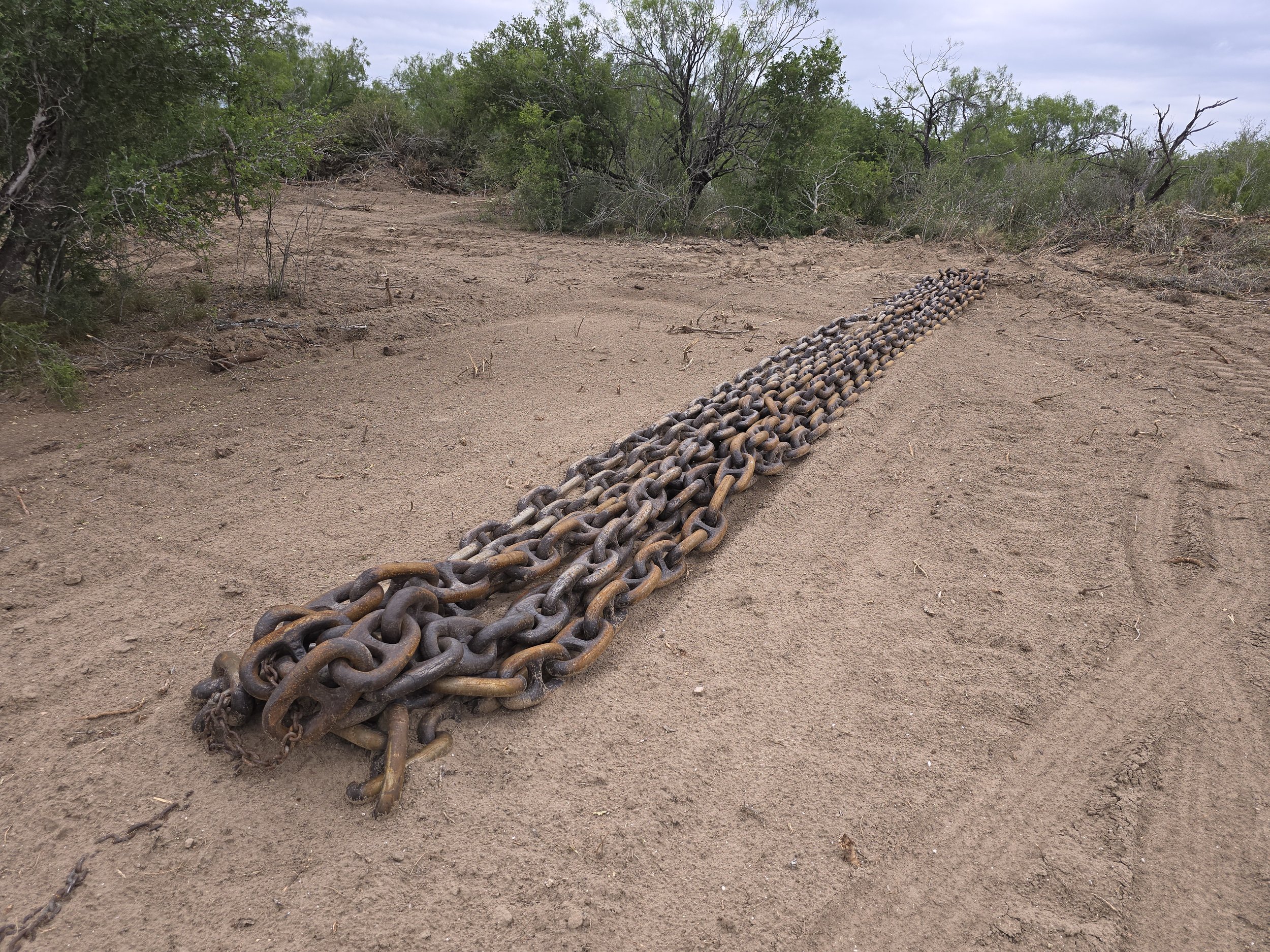
“Chaining” is a method by which a large ship-chain is dragged between two bulldozers to clear huge swaths of land of shrub and small-tree cover at once. It is commonly employed in the great basin, namely in Nevada and Idaho, but I saw it being done here in South Texas in the peyote gardens in March of 2023.
A Brilliant Strategy exemplified by a Neotropical Legume
Ice cream bean (Inga edulis) volunteers all over disturbed areas in the neotropics. It's a common snack, ready-to-wear and sold in markets, but the seeds are not tasty, only the pulp around them is, so they are discarded on road sides, where they germinate and then become trees. A very adaptive strategy for a plant, using humans to disperse its seeds.
It can be a hard one to grow in the wrong climate. It requires temps between 65-85° F (18-29 C) and ample humidity. I tried to grow it in South Texas, and it struggled for a year before dying, either from arid heat or prolonged chill during the month or two of temps below 50° F


A Strange Pollination Syndrome in Ecuador...
This Orchid species depends on a single species of pollinator for its pollination. What's more, it doesn't actually offer the pollinator any reward, but instead deceives the pollinator into visiting the flower by pretending to be the pollinators prey.
Phragmipedium pearcei tricks female hover flies (in the species Ocyptanthes antiphales) into visiting the flowers by producing spots on the inside of the flower's "pouch" that mimic aphids. This species of hover fly lays eggs in aphid colonies, and later the emerging larvae eat the aphids as they grow.
It's also quite likely that this flower produces pheromones that mimic the alert pheromones of aphids in order to help attract the hover flies - quite a few other orchid genera do this is as well, such as #Epipactis.
The hover fly flies into the "pouch" formed by the labellum petal and is temporarily trapped. When it finally escapes the flower, it is forced to exit through the top of the flower by the "moustache" structure on the staminode, where it then comes into contact with the stigma (the female part of the flower) and later the anther.
This "trap-and-release" pollination method is also used by plants such as the pipevines (genus Aristolochia), with which it seems to work pretty well.
The genus Phragmipedium is 1 of 5 genera in the orchid subfamily Cypripedioideae, known for producing two anthers instead of the standard one as well as the "slipper" or "pouch" shaped labellum (see last photo for picture of Orchid phylogeny and subfamilies).
Screenshot of pollinator taken from "Pollination of slipper orchids (cypripedioideae): A review" (Pemberton, 2013).



A Plantation Is Not a Forest
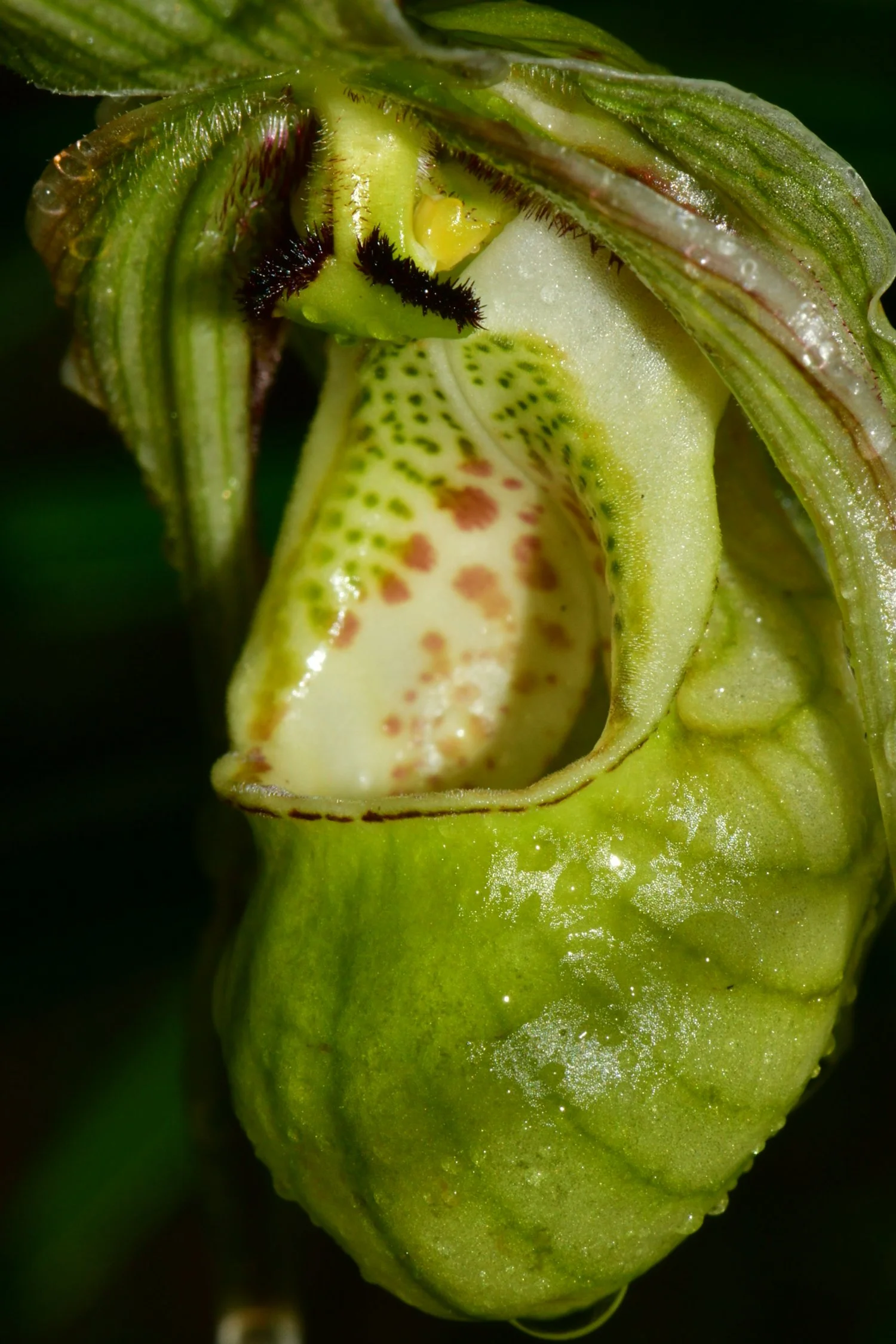
The amount of Radiata Pine and Eucalyptus Plantation that was planted in the 1970s and 80s due to a law that subsidized and encouraged private companies to destroy native forest and plant exotics is mind-boggling here in Chile.
While driving in between the few crumbs of protected habitat we have seen oceans, mile after mile, of planted non-native forest where there once was Nothofagus (the Southern beeches), Myrtle and Araucaria forest. The amount of destruction is excessive, and what has been lost is discouraging.
What leaves me hopeful, however, is seeing a burgeoning enthusiasm and reverence for native plants in Chilean culture and among young people here. Art featuring natives is common, and many here seem to embrace the rare plants which compose these special Southern Hemisphere forests and plant communities.



Ode to a rare Mustard
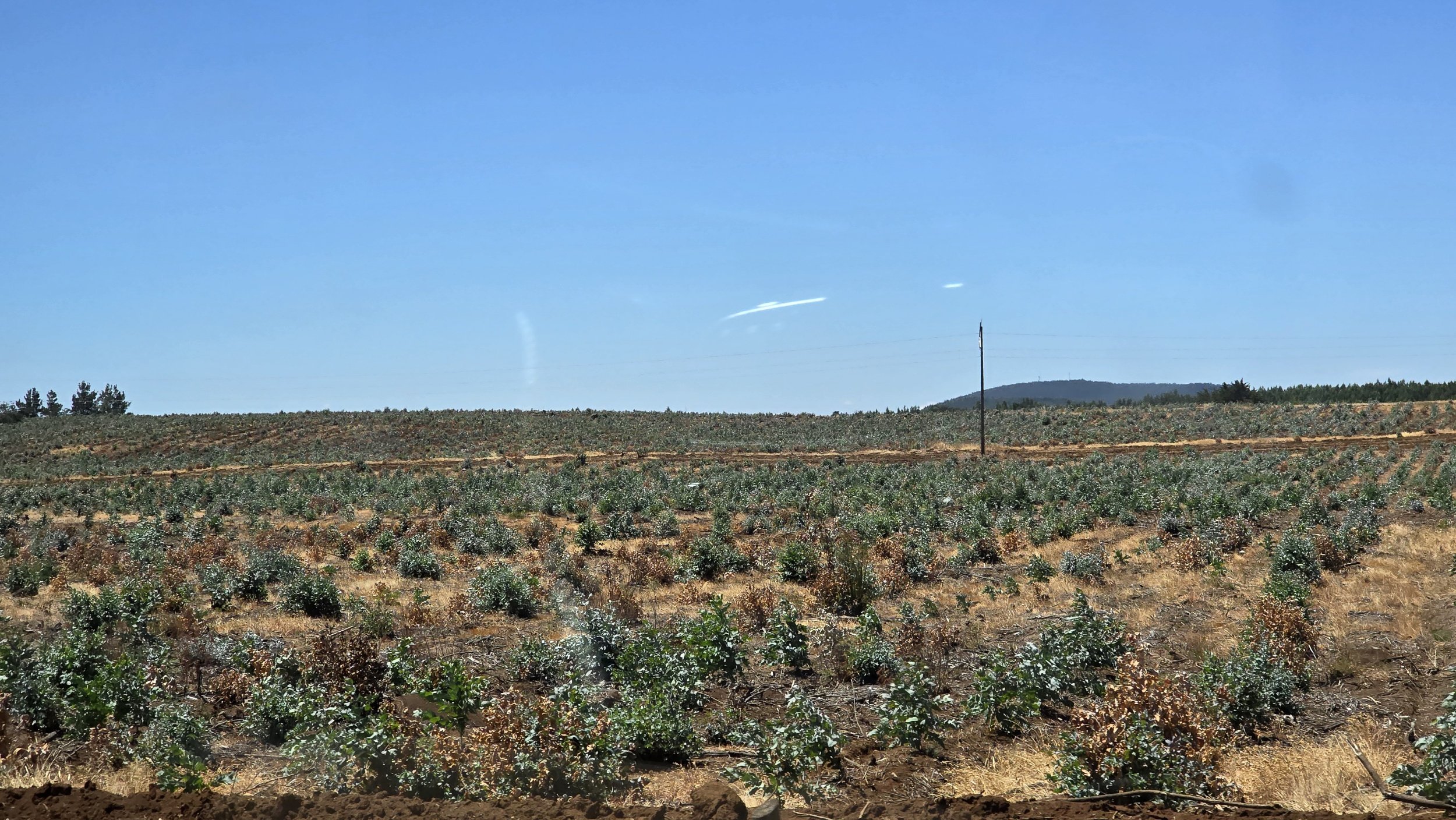
Thelypodiopsis shinnersii (syn. Mostacillastrum vaseyi) is a rare annual mustard that's seemingly much more rare than previously thought, most likely due to the same old culprits of habitat destruction and invasive grasses.
It was put on my radar by a friend who spotted it growing in Harlingen, Texas and couldn't figure out what it was. I don't know of many native Brassicas in the region either, and the ones I do know certainly were not this. I looked on SEINET and found only a few herbarium specimens, and when I got to the area - A disturbed patch of vegetation with Borrichia frutescens on the edge of an Ebony woodland I searched the area and couldn't find more than 20 plants.
Though I was pretty sure of the ID I still decided to consult Brassicaceae Expert Dr. Ihsan Al-Shabahz for ID confirmation, which came back positive. Nursery owner Mike Heep was familiar with the species, of course, and knew of a roadside patch North of Harlingen around here : 26.194051,-97.611724 but I found the place overgrown with the same invasive grasses and wasn't able to locate any individuals.
Regardless, it's a cool species with glaucous blue sessile leaves with an auriculate base and tiny white flowers, and it likely doesn't go too far inland as it doesn't seem adapted for drought, preferring instead to stick near Arroyos and waterways.


Feral Hogs Represent An Immediate Threat to Peyote
As if this species didn't already have enough threats facing it, now Peyote (Lophophora williamsii) can add feral hogs to the list of immediate threats to its existence. It seems the threat from hogs is much more extensive than thought.
Peyote, of course, is sacred to Native Americans who use it as a religious sacrament during all-night teepee ceremonies. It has been an important part of resisting the effects of colonization and genocide for indigenous people in North America, but it is curr facing some pretty severe threats, the most of which seems to be land clearance and an innate societal disrespect for the kind of habitat that Peyote grows in in South Texas: Tamaulipan Thornscrub.
When licensed Peyote dealers known as "Peyoteros" harvest Peyote, they merely cut it above its underground stem, leaving the stem intact so that dormant buds can re-sprout new "heads" (stems). When feral pigs eat Peyote, exploiting its water stores but apparently unbothered by the bitter alkaloids, they dig up the plants and leave them half-eaten to die slowly on the soil surface. The pigs also damage Peyote's nurse plants like Guajillo (Senegalia berlandieri) by chewing on the roots, causing it to die. These nurse plants are of immense importance not just to Peyote but to the entire ecosystem, since they mitigate the effects of the brutal summer heat and dry season, while also fixing nitrogen through their roots and making it available to other plants in the soil. Remove the nurse plants, and many of the cacti in this habitat will not have the shade necessary to make it through the summer.
What's really tragic to think about is the effects feral hogs will have on the long-term health of the habitat here. I'm hopeful we can eventually use PigBrig corral traps to get our problem under control, but what about the hundreds of other properties where habitat is being destroyed but the landowners are not paying attention and don't even care? This is how a species slowly gets wiped out from an area, which is something I've seen happen firsthand with other cactus species in South Texas. Suddenly, they're just not there anymore, and few seem to notice or remember.


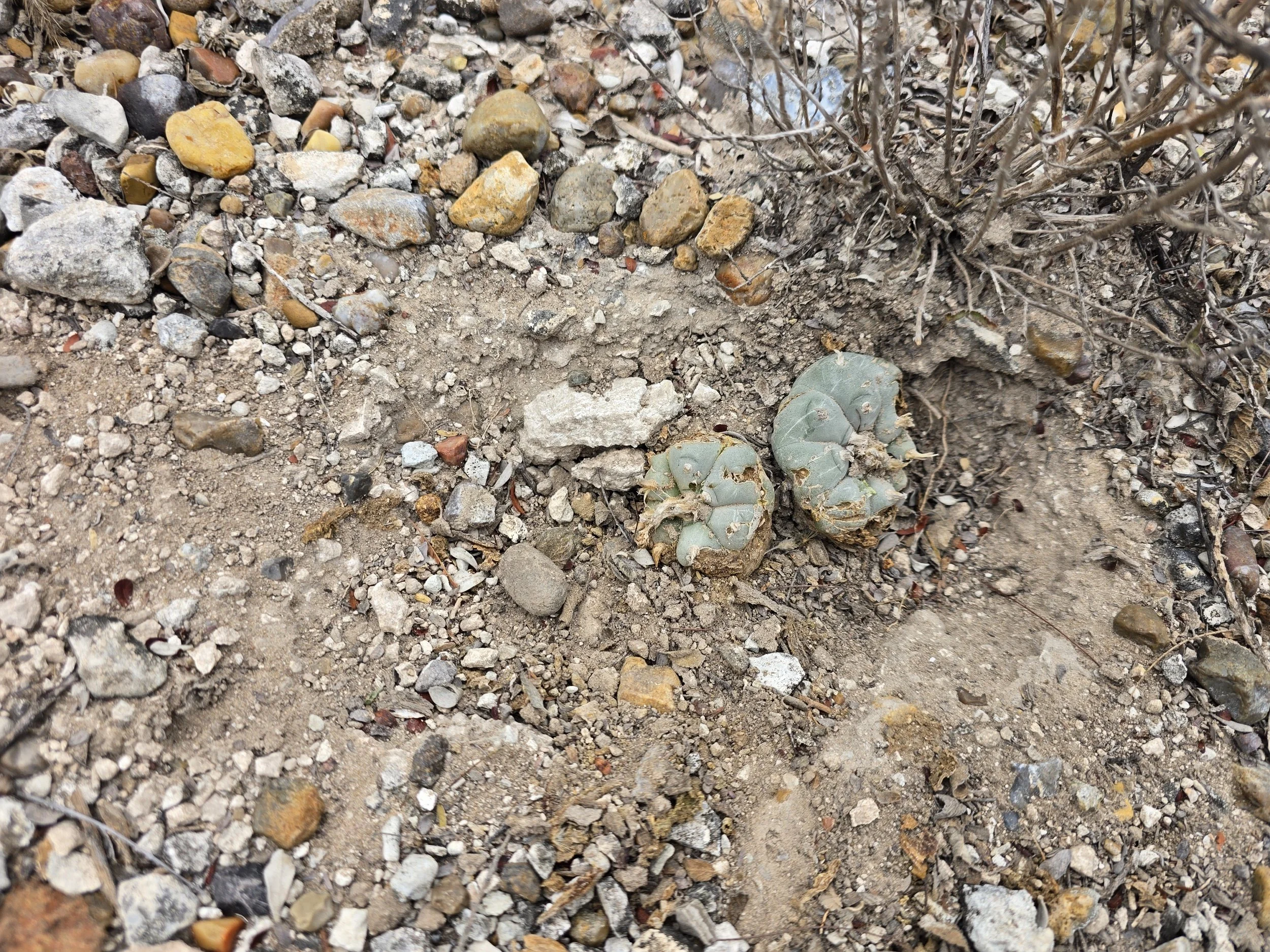


How Peyote Recovers from SunBurn
This was exciting to see, and illustrates how the epicuticular wax that reflects ultraviolet light and prevents "sunburn", especially at high temperatures when ultraviolet is the most damaging, can be regenerated directly by the epidermal tissue itself, and DOESN'T require new growth of epidermal tissue directly from the apical meristem itself.
The apical meristem is the point in the center and top of any cactus stem where new growth is generated. Cacti also have the potential of producing secondary growth in their cambium, but these lateral meristems (which eudicots have but monocots lack) can't generate new epidermis, they can only produce cork cells, a kind of protective secondary growth which is dead at maturity.
These plants originally got sunburned because we removed the invasive buffelgrass which was shading them out. Had we not done so, they would have eventually etiolated and effectively died of starvation. Since they had already been growing in shade for so long, they did not possess the "epicuticular wax" that gives peyote its blue color. Lacking this wax, they burned quickly within a day of exposure to the hot sun, but owing to peyote's excessive amount of storage tissue located in its underground stem, they recovered in only a few months. This illustrates how quickly Peyote - and many other cacti - can heal itself, and this underground stem is what makes the cutting of Peyote by members of the Native American church completely sustainable *when done correctly* and at appropriately spaced intervals. It's also what makes poaching and digging this plant such an unnecessary *completely DICK* move, as this is equivalent to stealing from the other life forms that depend on this plant and looting habitat of its biological richness.
My only regret is that we did not come back to check on these plants sooner so that we could accurately measure how quick they recovered.
